Google I/O 2026: The Day AI Transitioned from Predicting Text to Simulating Reality
On This Page
- 1. Gemini Omni Flash: True Multimodal Generation
- 2. Antigravity 2.0 & Gemini Spark: The Golden Age of Agentic Frameworks
- 3. The Search Engine Reimagined
- 4. Stitch, Flow, and Google Picks: Redefining the Creative Workflow
- 5. Smart Eyewear, Project Genie, and SynthID
- Conclusion: The Gemini 3.5 Default
Key Takeaways
- Google I/O 2026 shipped the biggest set of AI updates in a 24-hour period, with $190B in CapEx committed to rebuilding every product with AI natively underneath
- Gemini Omni Flash merges deep worldly reasoning with generative capabilities — producing videos grounded in real scientific understanding, not just visual aesthetics
- Antigravity 2.0 reduces the entire agentic development framework to a chat interface, spinning up specialized agents that autonomously debug and refactor code
- Google Search received its first complete architectural redesign in 25 years with generative UIs, interactive simulations, and persistent AI agents living in the search bar
- Smart eyewear, Stitch/Flow creative tools, and SynthID adoption by OpenAI/Eleven Labs mark Google's platform-level AI dominance
🔗 Back to Home: SimpleAIGuide.tech 📚 Explore More:
- Google I/O 2026 — Every Major AI Announcement Explained (Deep Dive)
- Best AI Tools for 2026 — Ranked by Real ROI
- Andrej Karpathy Joins Anthropic — What It Means for AI & Jobs
- Titans Memory Architecture — The Future Beyond Transformers
If you thought the AI space was moving fast before, Google I/O 2026 just strapped a rocket to the timeline. In what is easily the single biggest set of AI updates any company has released in a 24-hour period, Google demonstrated a fundamental shift in their strategy. We are no longer just talking about chatbots predicting the next word in a sentence; we are looking at systems that simulate reality, orchestrate complex parallel tasks, and live seamlessly on our devices (and our faces).
With a staggering $190 billion in CapEx committed to making this happen, Google isn’t just adding AI features to their products anymore — they are rebuilding every single surface they own with AI natively underneath. From agentic frameworks that write code to smart glasses challenging Meta’s dominance, here is the comprehensive breakdown of the most crucial updates you need to know.
1. Gemini Omni Flash: True Multimodal Generation
Google has officially shipped Gemini Omni Flash, a model that merges deep worldly reasoning with from-scratch generative capabilities. The standout debut feature? Video generation with actual depth.
Historically, AI video generators created visually pleasing but fundamentally “hollow” clips that lacked an understanding of the subject matter. Omni changes this. By combining text, images, audio, and video inputs, it builds videos grounded in reality. During the keynote, a prompt asking for an accurate “claymation explainer of protein folding” resulted in a scientifically flawless video. The AI understood amino acid chains, helices, and 3D structures, narrating and animating them perfectly in real-time. No scripts or research papers were required — just a single prompt and Gemini’s inherent world knowledge.
2. Antigravity 2.0 & Gemini Spark: The Golden Age of Agentic Frameworks
For those of us actively building and deploying agentic workflows, the update to Google Antigravity is nothing short of revolutionary. Antigravity 2.0 has stripped away the intimidating, code-heavy IDE interface of the past. The entire application is now a streamlined chatbox designed specifically for orchestrating multiple AI agents in parallel.
To test its limits, the system was prompted to “Make a Chrome Dino infinite runner game that plays itself in a cyber theme” using the Gemini 3.5 Flash model. Within seconds, the framework spun up specialized agents to handle styling, movement logic, and audio. When the game hit a loading error in the browser, the user simply typed “This is not working.” The agentic system autonomously investigated, tested multiple approaches, and debugged the application. Even more impressively, as the AI player repeatedly crashed in-game, the agents recognized the failure and refactored the jump logic on the fly — resulting in a fully functional, self-playing cyber-Dino game with zero manual code written.
Alongside this is Gemini Spark, a 24/7 autonomous personal agent running constantly on Google Cloud. Integrated deeply with Workspace, Spark can monitor inboxes, flag hidden credit card fees, and even autonomously add requested items to your Instacart, waiting only for your final payment approval.
3. The Search Engine Reimagined
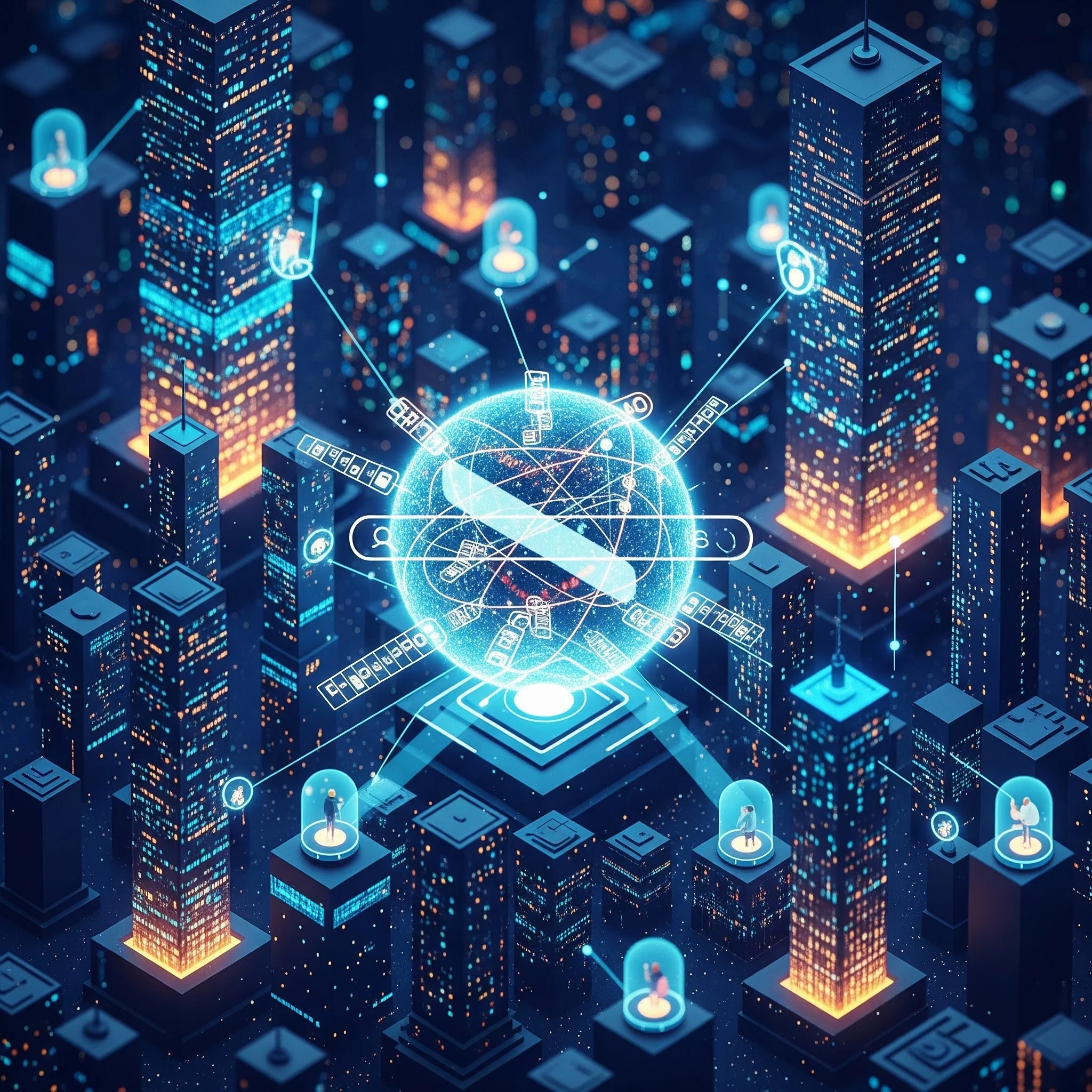
For the first time in 25 years, Google Search has undergone a complete architectural redesign. The search bar is no longer just for text; you can drop in images, files, or even open Chrome tabs. But the real magic lies in its generative UI and embedded agents.
If you search for complex topics like astrophysics or the mechanics of a watch, Google won’t just hand you blue links — it will generate an interactive simulation directly on the results page. If you want a fitness tracker, it builds a functional mini-app using real-time maps and weather data right in the browser.
Furthermore, Google has placed persistent AI agents directly into the search bar. You can instruct Search to track a specific sneaker drop or find a late-night private karaoke room, and the agent will monitor the web 24/7, sending you a notification the second a match is found.
4. Stitch, Flow, and Google Picks: Redefining the Creative Workflow
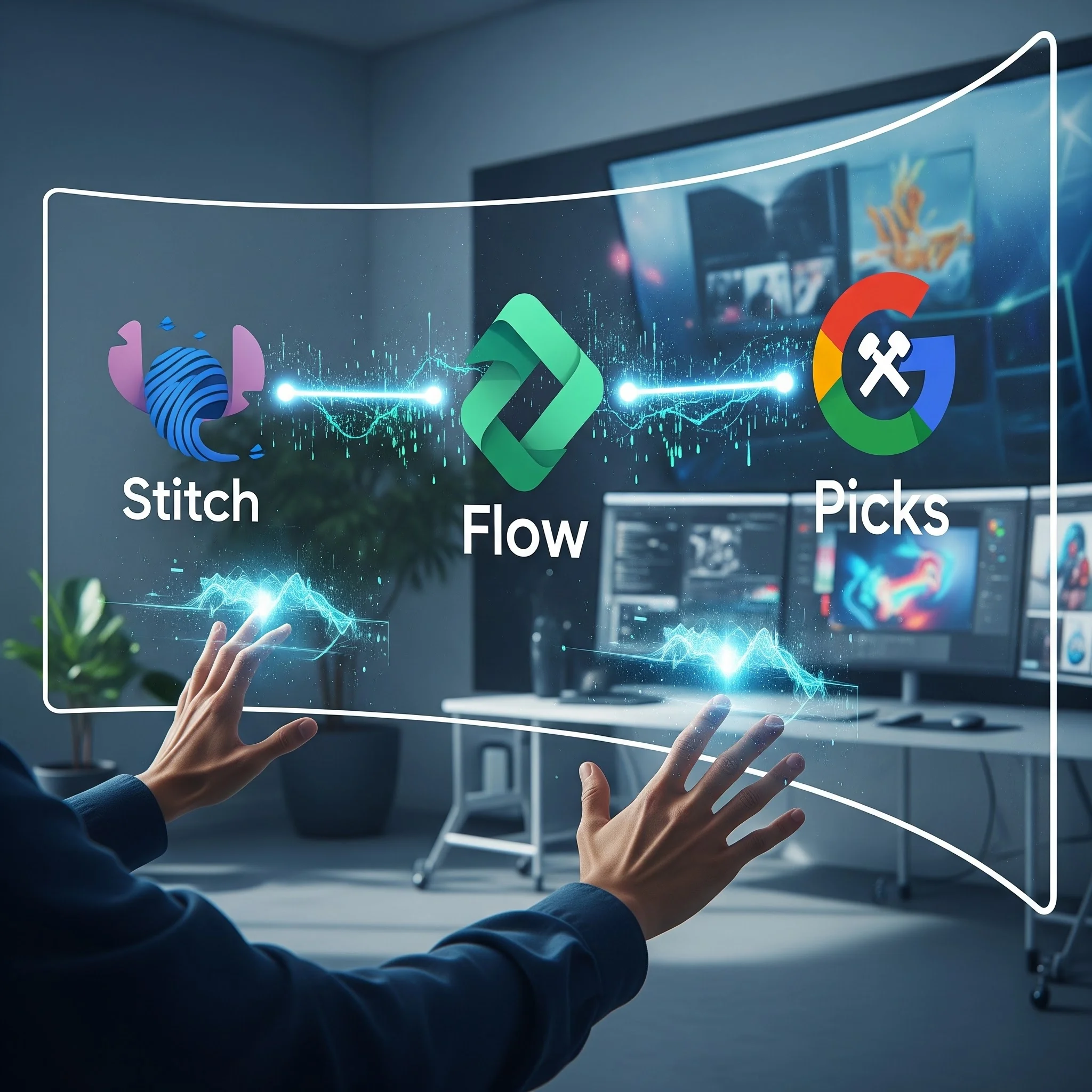
The creative suite saw massive upgrades, closing the gap between design and functional code:
-
Stitch (UI Design): Now features real-time streaming renders, allowing you to steer designs as the AI generates them. You can import existing Figma files or entire codebases, apply in-place AI edits to specific elements, and build real HTML-native animations. It is the ultimate tool for founders who want to handle the design-to-code loop in one place.
-
Google Picks: Powered by Nano Banana 2, this isn’t just an image generator — it’s an object-aware editor. You can select, move, and transform individual elements inside a generated image, edit text natively, and collaborate with others in real-time, directly challenging Canva’s dominance.
-
Flow Tools & Flow Music: “Vibe coding” is here. You can build custom creative software tools (like color shaders or video resizers) just by describing them in plain English. For audio, Lyria 3 Pro allows you to isolate and edit specific stems of a song — like changing the beat drop without affecting the vocals.
5. Smart Eyewear, Project Genie, and SynthID
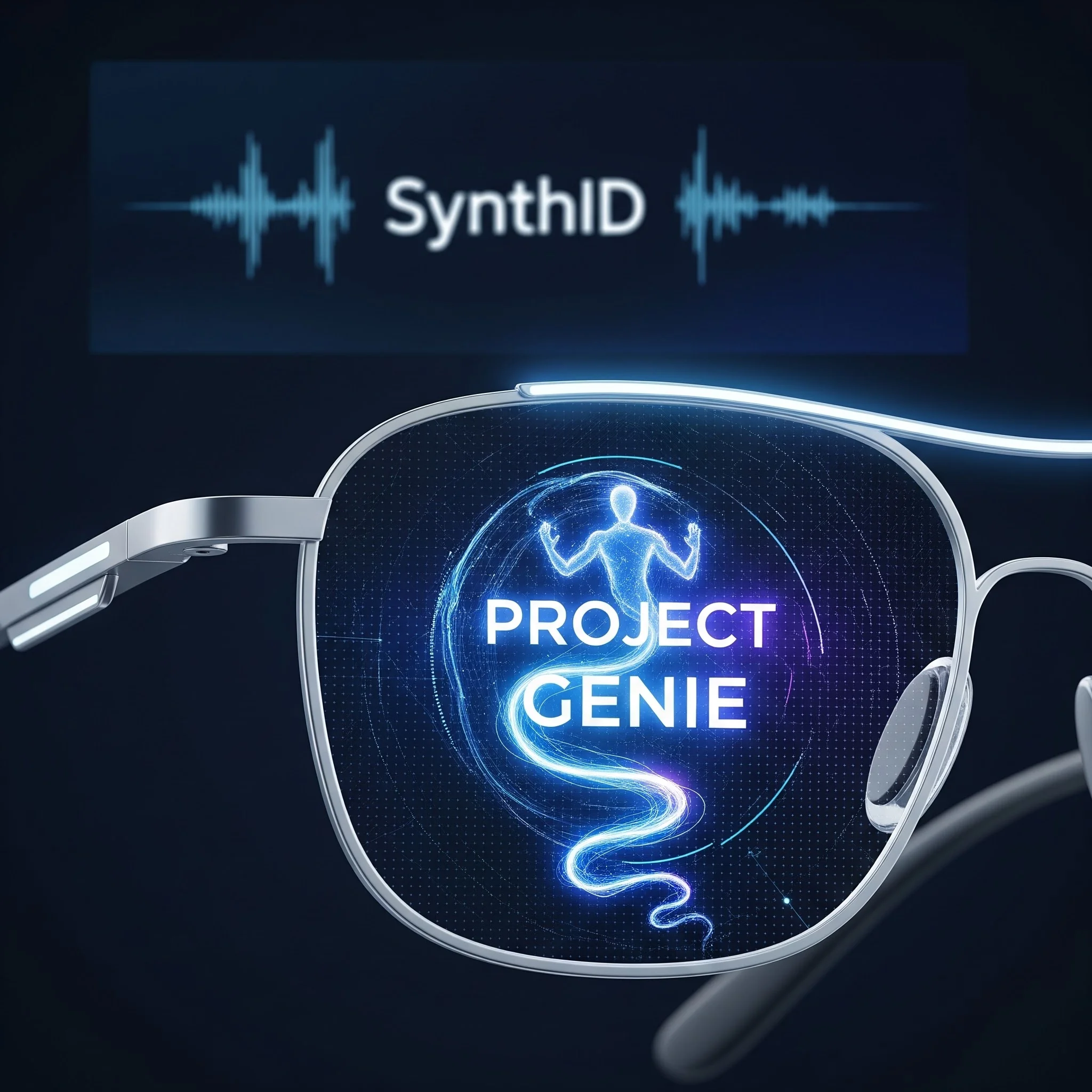
Google is officially re-entering the smart glasses arena in partnership with Samsung, powered by Android XR. Taking the fight directly to Meta’s Ray-Bans, these glasses come in audio and display variants, offering real-time visual navigation, translation, and environmental context directly to your face.
In the digital realm, DeepMind’s Project Genie can now plug into Google Maps Street View, allowing users to transform real-world locations (like the Golden Gate Bridge) into fully playable, interactive virtual worlds styled as an Ocean World or the Stone Age.
With all this generative power, security is paramount. Google’s invisible watermark, SynthID, has already tagged over 100 billion images and videos. In a massive win for digital transparency, OpenAI, Kakao, and Eleven Labs have all officially adopted SynthID to watermark their respective AI-generated content.
Conclusion: The Gemini 3.5 Default
All of these updates are powered by the newly shipped Gemini 3.5 Flash. Operating at four times the speed of competing frontier models and at a fraction of the cost, 3.5 Flash is set to become the new default for developers building out the next generation of applications.
For more on how Gemini 3.5 Flash compares to other frontier models, see our Best AI Tools for 2026 guide.
Google I/O 2026 proved one thing: the AI novelty phase is over. We are now in the deployment phase, where AI acts, orchestrates, and simulates. Keep an eye on simpleaiguide.tech as we continue to test and break down these agentic frameworks in the coming weeks.
💡 Want more AI guides, tutorials, and industry analysis? Visit: SimpleAIGuide.tech
📚 Further Reading:
- Google I/O 2026 — Every Major AI Announcement Explained (Deep Dive)
- Best AI Tools for 2026 — Ranked by Real ROI
- Andrej Karpathy Joins Anthropic — AI Job Disruption Analysis
- Titans Memory Architecture — The Future Beyond Transformers
- Geoffrey Hinton’s AI Warning for 2025
Written by Simple AI Guide Team
We are a team of AI enthusiasts and engineers dedicated to simplifying artificial intelligence for everyone. Our goal is to help you leverage AI tools to boost productivity and creativity.
Personally Tested by Our Team
This article and all recommended tools were reviewed with real prompts, hands-on checks, and editorial QA before publishing.
Testing Methodology
We test each AI tool using standardized prompts across 5 categories: accuracy, speed, ease of use, value, and unique features.
Content Last Updated
Last reviewed and updated on May 23, 2026. We'll update again when new versions are released.
Discussion
Comments powered by Supabase
Continue Reading
Related Articles
Google I/O 2026: Every Major AI Announcement Explained — The Biggest 24 Hours in AI History
Complete breakdown of Google I/O 2026: Gemini 3.5 Flash, AI-powered Search redesign, Gemini Spark agents, Anti-Gravity 2.0, Google Flow, SynthID, Smart Glasses, and 16+ major AI announcements explained.
Read moreThe Google I/O 2026 Megadrop: Autonomous Agents, Multimodal World Models, and the Changing Fabric of the Web
Complete deep dive analysis of Google I/O 2026 — Gemini 3.5 Flash vs Claude Opus 4.7, Gemini Omni multimodal world model, Gemini Spark & Antigravity 2.0 autonomous agents, Universal Cart, AI-driven Search overhaul, AR glasses with SynthID, and the broader AI industry shakeup.
Read moreThe Day Code Editors Vanished: Inside Google's Forced Pivot to Antigravity 2.0
Google phased out traditional editors in favor of Antigravity 2.0 — an AI-native development ecosystem powered by Gemini 3.5 Flash and managed agents. Complete analysis of the pivot, backlash, and what it means for developers.
Read more