
Hermes Agent: The AI Agent That Grows With You
On This Page
- The AI Agent That Gets Better Every Single Day You Use It
- 1. What Is Hermes Agent and Who Built It?
- The Origin Story That Changes the Context
- What Kind of Tool Is It?
- 2. Installation: Getting Hermes Running in Minutes
- Prerequisites
- One-Command Installation
- The Telegram Setup
- Verification
- 3. The Memory System: Why Hermes Stays Sharp While Others Get Bloated
- The Bloat Problem in Agent Memory
- Two Memory Files, Hard Size Limits
- Proactive Memory Updates Every Ten Turns
- Honcho: Optional Deep Personalisation
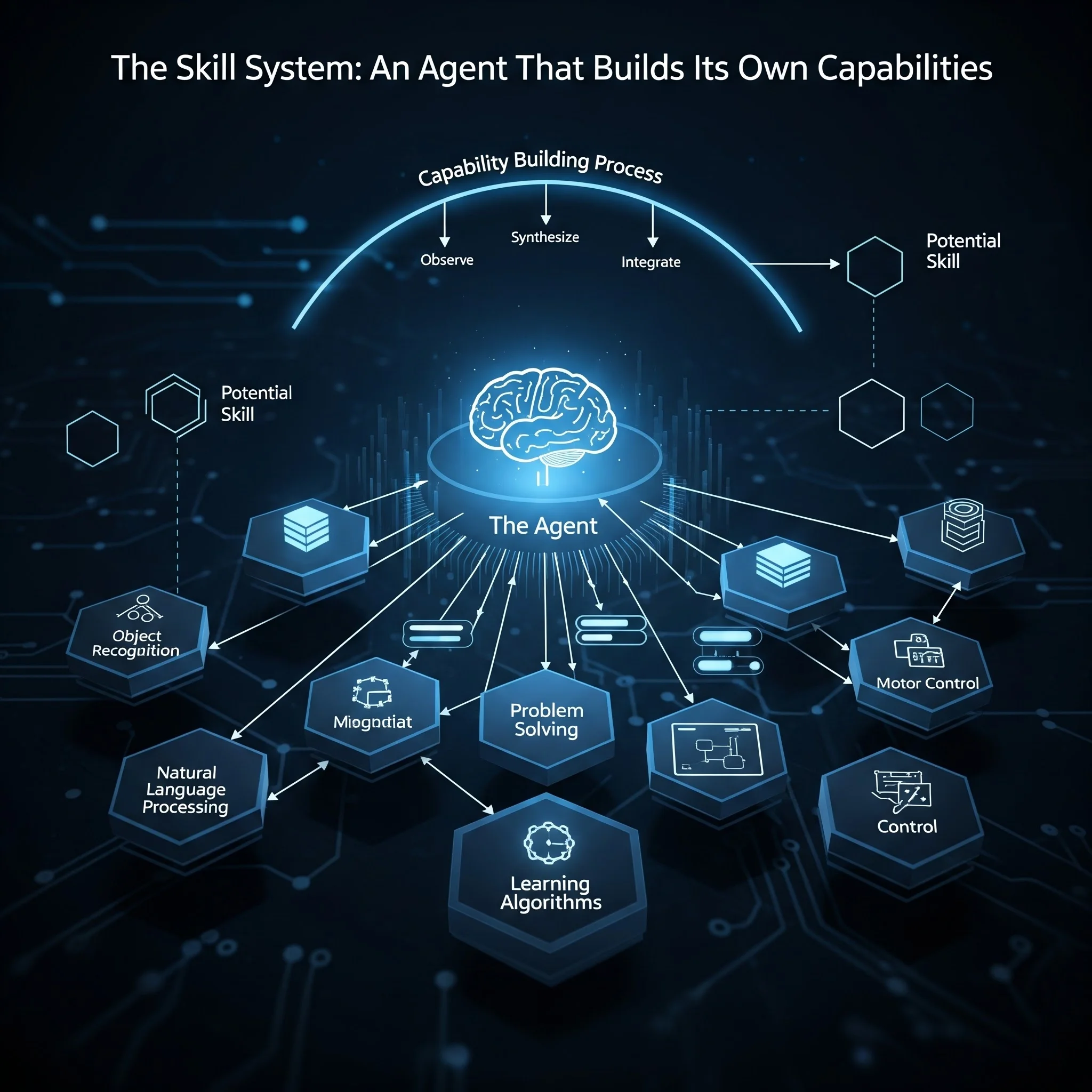
- 4. The Skill System: An Agent That Builds Its Own Capabilities
- What Skills Are
- The Self-Improvement Loop
- The Curator: Preventing Skill Bloat
- Built-In vs. Community Skills
- Hermes vs Claude Code: Feature Comparison
- 5. Real-World Use Cases: What Hermes Can Actually Do
- IT Infrastructure Management
- Smart Home and Automation Control
- Team Collaboration and Support
- Personal Productivity and Family Use
- Asynchronous Task Execution via Kanban
- 6. The Philosophy Behind Hermes: Why It Matters Who Builds Your Tools
- A Mission, Not Just a Product
- The “Get Out of the Agent’s Way” Principle
- Open Source as a Safety Mechanism
- 7. Should You Switch? An Honest Assessment
- Switch to Hermes If You:
- Stick with Claude Code or Consider Alternatives If You:
- The Migration Path
- Final Thoughts: A Different Kind of AI Agent
- Further Reading
- Official Resources
Key Takeaways
- Hermes Agent uses enforced memory curation with hard size limits (USER.md: 1,375 chars, MEMORY.md: 2,200 chars) preventing the context bloat that plagues other agents.
- The self-improvement loop automatically crystallises workflows into reusable skills from your actual usage, making the agent genuinely more capable over time.
- Proactive memory updates every 10 conversational turns keep the agent sharp during sessions, unlike agents that only update at session boundaries.
- Open-source, model-agnostic, and built by Nous Research from months of internal use before public release — not rushed to compete with Claude Code.
- The Curator agent actively manages the skill library, preventing bloat by archiving stale skills and improving frequently used ones.
Hermes Agent: The AI Agent That Grows With You — 5 Reasons Developers Are Switching from Claude Code to Hermes
🔗 Back to Home: SimpleAIGuide.tech 📚 Explore More Guides:
- DeepSeek TUI: The Free Terminal Coding Agent
- How AI Is Transforming Cybersecurity
- Andrej Karpathy Joins Anthropic: What It Means for AI
- Google I/O 2026 AI Announcements
Published on SimpleAIGuide.tech | Category: AI Developer Tools | Reading Time: ~14 minutes
The AI Agent That Gets Better Every Single Day You Use It
If you have spent any time with AI coding and productivity agents, you are probably familiar with a particular kind of disappointment. Day one feels magical. The agent is responsive, helpful, and impressive. But by day thirty, something has shifted. The context is bloated. The responses feel generic. Updates break things unexpectedly. What started as a powerful tool has become a project in itself — something you have to maintain and fix rather than something that works for you.
That frustration is exactly what drove thousands of developers to try Hermes, the open-source AI agent built by Nous Research. And it is exactly the problem that Hermes was designed to solve. Not just with better engineering, though the engineering is genuinely better. But with a fundamentally different philosophy about how an AI agent should work: one that gets smarter about you over time, builds its own skills based on your specific workflows, and stays sharp rather than bloating — all without requiring you to manage any of it manually.
Hermes is now the fastest-growing AI agent project on GitHub. It has surpassed Claude Code on OpenRouter token usage. It is the agent people are giving to family members who have never configured a developer tool in their lives. And it was built by a team of AI researchers who had been running their own version internally for months before Claude Code even launched.
This guide covers everything you need to know about Hermes: what makes it genuinely different, how its memory and skill systems work, how to install it, and whether it is worth switching from whatever agent you are using today.
Key Claim: Hermes is designed to be measurably better on day 30 than day one — not through manual configuration, but through an automated self-improvement loop that builds skills from your actual workflows.
1. What Is Hermes Agent and Who Built It?
Hermes Agent is an open-source AI agent harness built by Nous Research, a company founded by a group of AI researchers and open-source hackers who came together on Discord with a shared mission: building humanistic, censorship-free, and democratic AI. The name Hermes is not new to Nous Research — they have been training their own open-source Hermes language models for years. The agent framework is a separate but philosophically aligned product.
The Origin Story That Changes the Context
Here is something most people covering Hermes miss: it was not built as a response to Claude Code. Nous Research had already been running Hermes internally for six to seven months before Claude Code launched publicly. They were using it to prototype recursive self-improvement workflows for model training. When Claude Code came out and the team tried it, their reaction was telling. It felt clunkier compared to what they already had. So they released their own version.
That context matters for two reasons. First, Hermes was not rushed out to compete — it emerged from genuine internal use and was already mature when it went public. Second, it was built by people who train AI models for a living, which means they approached the agent design with a different mental model than a product team building a developer tool.
What Kind of Tool Is It?
Like Claude Code and other terminal agents, Hermes is a harness — a framework that wraps an underlying language model and gives it tools to interact with the real world: reading files, running shell commands, searching the web, controlling applications, and executing multi-step tasks. The model itself is pluggable: you can use it with OpenAI models, Anthropic’s Claude, local models via LM Studio, or any provider available through OpenRouter. If you already pay for a ChatGPT subscription, you can use that as the brain for Hermes at no additional cost.
“The harness is the haptic feedback to the model of the world. The model is the brain. We just needed to give it the hands, the feet, the fingers to touch the world in an appropriate way.” — Jeffrey Quesnelle, Co-founder of Nous Research
2. Installation: Getting Hermes Running in Minutes
One of Hermes’ genuine strengths is how straightforward the installation process is. Unlike some agent frameworks that require managing Python environments, configuration files, and dependency trees before you can do anything, Hermes installs with a single command and walks you through setup interactively.
Prerequisites
- A server or computer to run it on — works on Linux, macOS, and Windows (native Windows support is in active development). A cloud VPS running Ubuntu is an excellent choice for 24/7 availability.
- An API key for your chosen model provider — OpenAI, Anthropic, OpenRouter, or a local LM Studio setup
- A Telegram account if you want to use the Telegram messaging interface (recommended for mobile access)
One-Command Installation
Navigate to the Hermes GitHub repository and copy the installation command. In your terminal:
curl -sSL https://get.hermesagent.io | bashThe installer handles dependencies, sets up the Python environment, and launches an interactive configuration wizard. The wizard walks you through:
- Choosing your inference model and provider
- Authenticating with your chosen provider
- Selecting your model (GPT-4.5, Claude Sonnet, Qwen, or others)
- Setting up your messaging interface (Telegram, terminal, or others)
- Configuring security settings including user access control
The Telegram Setup
Telegram is the recommended messaging interface because it works seamlessly on mobile and desktop, requires no additional configuration beyond a bot token, and gives you a clean conversational UI. The setup involves talking to Telegram’s BotFather to create a new bot, copying the token into Hermes, and adding your Telegram user ID so the agent only responds to authorised users. The whole process takes about five minutes.
Verification
Once installed, you can talk to your agent directly in the terminal or via your chosen messaging interface. Hermes will show you available built-in skills at the top of the interface, and you can immediately start giving it tasks. If you are migrating from Claude Code, Hermes provides a documented migration path that moves your existing memory and configuration files across with minimal friction.
Cloud Deployment: Running Hermes on a cloud VPS means your agent is always available, can run long tasks while your laptop is closed, and has access to a consistent environment. A KVM-2 tier VPS handles Hermes comfortably alongside other workloads.
3. The Memory System: Why Hermes Stays Sharp While Others Get Bloated
Memory is probably the single most important differentiator between Hermes and other AI agents — and it is the reason that agents which feel great on day one start feeling clunky by day thirty. Understanding how Hermes handles memory differently requires understanding what the problem actually is.
The Bloat Problem in Agent Memory
Every AI agent needs to load context into the model’s system prompt when starting a session — information about who you are, your preferences, your environment, and previous interactions. The problem is that this context grows over time. Every conversation adds more information. Eventually, you have a massive blob of context that the model has to process at the start of every session. Much of it is outdated, irrelevant, or redundant. The model’s attention is spread thin across too much information, and the quality of responses degrades.
Most agents address this poorly — either by letting context grow indefinitely until it hits limits, or by requiring manual pruning that users rarely do. Hermes addresses it systematically.
Two Memory Files, Hard Size Limits
Hermes uses two structured memory files that are loaded into the system prompt at the start of each session:
- USER.md: Information about you — your name, role, preferences, working style, and context relevant to how the agent should interact with you. Hard limit: 1,375 characters.
- MEMORY.md: Information about the environment — the systems the agent has access to, technical details about your infrastructure, tools and configurations it needs to know. Hard limit: 2,200 characters.
These hard limits are not arbitrary. They force the agent to be deliberate about what is actually important enough to preserve. When a memory file approaches its limit, the agent must decide what to keep and what to remove — effectively curating its own context to preserve the most valuable information and discard what has become stale or irrelevant.
This self-curation happens automatically, without you managing it. The agent decides what matters based on what has been useful in recent interactions. Over time, the memory files become increasingly well-calibrated to your actual working patterns.
Proactive Memory Updates Every Ten Turns
The second major memory innovation is when updates happen. Most agents — including Claude Code — only update memory files when you are about to compact context or start a new session. This means memory can become outdated during long working sessions.
Hermes runs a background memory review approximately every ten conversational turns. It checks whether anything discussed in the recent conversation should update the USER.md or MEMORY.md files, and makes those updates in real time during the session. Your agent is continuously learning about your current work, not just accumulating historical context.
Honcho: Optional Deep Personalisation
For users who want an even deeper level of personalisation, Hermes integrates with Honcho — a companion service that builds a detailed model of who you are over time. Every message you send is also processed by Honcho, which reasons over your communication patterns, preferences, working habits, and personality traits to build a “peer card” — a structured profile that is used to provide contextually relevant information to your agent at query time.
The practical effect is that your agent does not just know your name and technical preferences. Over weeks of use, it develops a nuanced understanding of how you think, what you find frustrating, what energises you, and what context is most useful in different situations. It is a significantly more sophisticated personalisation system than most enterprise software provides, available as an open-source integration.
Key Difference vs Claude Code: Claude Code memory tends to bloat over time without active management. Hermes enforces hard memory limits and performs proactive curation every 10 turns, keeping the agent sharp and focused automatically.

4. The Skill System: An Agent That Builds Its Own Capabilities
If the memory system is why Hermes stays sharp over time, the skill system is why it gets genuinely more capable. This is the feature that most clearly differentiates Hermes from every other agent framework — and it is the one that the Nous Research team describes as the heart of the product.
What Skills Are
A skill in Hermes is a crystallised, reusable workflow — a structured description of how to accomplish a specific type of task that the agent has learned from actually doing it. Think of it like a procedure that the agent writes for itself after figuring out how to do something for the first time.
The first time you ask your agent to set up a VPN client, it figures it out through a process of research, trial, and error. That process involves a series of tool calls, command executions, and reasoning steps. When the task is complete, Hermes’ self-improvement review triggers automatically and evaluates whether this experience should be crystallised into a skill. If it should, it creates a skill called something like “VPN Client Operations” — a structured workflow that captures what it learned.
The next time a VPN-related task comes up, the agent does not have to rediscover the process from scratch. It has the skill. It is faster, more reliable, and more confident.
The Self-Improvement Loop
The process by which Hermes creates and refines skills is called the self-improvement loop, and it mirrors — in a crude but meaningful way — how humans develop expertise. The loop works as follows:
- Agent encounters a novel task and works through it using available tools and reasoning
- After completing the task, the self-improvement review evaluates the interaction
- If the interaction represents a reusable workflow, a new skill is created
- The Curator agent periodically reviews all existing skills, improving high-value ones and archiving or removing stale ones
- Skills progress through states: Active (currently used), Stale (not recently relevant), Archived (removed from active use)
This means the agent’s skill library is not a static set of pre-installed capabilities. It is a living, evolving collection that reflects the specific work you do with your agent. An agent used for infrastructure management will develop a completely different skill set from one used for content creation or software development.
The Curator: Preventing Skill Bloat
A potential problem with automatic skill creation is accumulation — skills piling up indefinitely until the library becomes unwieldy. Hermes addresses this with the Curator, a background agent that periodically reviews the skill library and actively manages it. The Curator:
- Improves skills that are frequently used and could be made more efficient
- Marks as stale skills that have not been triggered recently
- Archives skills that are no longer relevant
- Identifies gaps where new skills should be created
The result is a skill library that stays lean and high-quality rather than growing into an unmaintained collection that the agent cannot use effectively.
Built-In vs. Community Skills
Hermes ships with a curated library of built-in skills created by the Nous Research team from their own internal workflows. These represent high-quality, thoroughly tested procedures for common tasks. The GitHub PR review skill, for example, was built from thousands of internal code reviews and captures a genuinely rigorous review process.
The philosophy here is deliberately conservative. Rather than hosting an open marketplace where anyone can publish skills — an approach that created security problems for Claude Code, which had documented vulnerabilities from unvetted community skills — Hermes keeps its built-in library carefully curated and relies on the self-improvement loop to build custom skills organically from each user’s actual workflows.
“The skill system is the ability for the agent to crystallise, once it has seen how you operate, learnings down into a meaningful chunk that it can then reuse. We modelled it after how we ourselves work — we struggle through things, figure out ways to solve hard problems, note that down, and iterate on those successes.” — Jeffrey Quesnelle, Co-founder of Nous Research
Hermes vs Claude Code: Feature Comparison
| Feature | Hermes Agent | Claude Code |
|---|---|---|
| Memory management | Automatic with hard limits, curated every 10 turns | Manual or session-based; prone to bloat |
| Skill system | Self-building from workflows via self-improvement loop | Marketplace model; community skills (security risks noted) |
| Model provider | Any (OpenAI, Anthropic, OpenRouter, local) | Anthropic models only |
| Open source | Fully open source | Proprietary |
| Stability | Stable; built from years of internal use | Update-related breakage reported by many users |
| Day 30 vs Day 1 | Improves — sharper context, better skills | Often worse — bloated context, degraded responses |
| Installation | Single curl command (curl -sSL https://get.hermesagent.io | bash) | npm install; simpler for Node.js users |
| Messaging interfaces | Telegram, terminal, and others (curated selection) | Terminal-primary |
| Ecosystem maturity | Newer; rapidly expanding | Mature, large community |
| Dashboard UI | Terminal + Telegram | Terminal-primary |
| Security track record | Clean; curated skills only | Several CVEs from community skill marketplace |
5. Real-World Use Cases: What Hermes Can Actually Do
The most convincing argument for any tool is what it does in practice. Here are concrete examples of the kinds of tasks Hermes handles well, drawn from real usage.
IT Infrastructure Management
One of the most compelling use cases for Hermes is as a persistent IT agent with access to your network infrastructure. The workflow looks like this: install a headless VPN client on the agent’s server to give it access to your local network, then simply tell the agent to manage specific systems. Rather than pre-programming the agent with specific skills, you treat it like a new IT hire: give it access credentials and tell it what it needs to manage. It researches the relevant tools and APIs, figures out how to accomplish the required tasks, and builds skills from those experiences.
An agent deployed this way will, over time, develop a comprehensive skill set tailored specifically to your infrastructure — your specific switches, your specific monitoring tools, your specific deployment workflows. No two users’ agents end up with the same skill library, because they have been built from genuinely different real-world workflows.
Smart Home and Automation Control
Hermes ships with a Home Assistant integration that allows natural language control of smart home devices. Rather than navigating apps or using voice commands with rigid syntax, you simply describe what you want: turn off the lamp in the study, close the kitchen blinds, set the office to focus mode. The agent handles the API calls and remembers the layout of your devices across sessions.
Team Collaboration and Support
The Nous Research team itself uses Hermes agents in their internal Discord channels as team members. A Hermes agent configured as a system administrator participates in support channels, answers technical questions, and has built up a comprehensive skill set for debugging their specific infrastructure through months of real interactions. New team members can ask the agent questions and get answers informed by months of institutional knowledge that the agent has accumulated and organised into skills.
Personal Productivity and Family Use
Perhaps the most telling indicator of Hermes’ quality is that it is the agent people are comfortable giving to family members without technical backgrounds. Use cases in this category include:
- Homeschool planning and curriculum management
- Diet planning and grocery list generation
- Household task tracking
- General question-answering
The agent’s ability to remember context across sessions and adapt to the specific needs of its user makes it genuinely useful for non-technical applications.
Asynchronous Task Execution via Kanban
A recent addition to Hermes is a Kanban board interface that allows you to assign tasks to your agent asynchronously. You describe a task, assign it to an agent profile, and the agent works through it in the background — reporting progress, pausing for human input when needed, and completing the work even when you are not actively monitoring it. This makes Hermes practical for longer-running tasks like research projects, multi-file code changes, and content generation workflows.
6. The Philosophy Behind Hermes: Why It Matters Who Builds Your Tools
One of the reasons Hermes has developed such a loyal following quickly is not just the technical quality of the product — it is the philosophy of the people building it. In an AI landscape increasingly dominated by large companies with commercial interests that may not align with users’ interests, Nous Research represents something different.
A Mission, Not Just a Product
Nous Research was founded by a group of researchers who found each other because of a shared commitment to making humanistic, censorship-free, and democratic AI. They began by training their own open-source language models — the Hermes model series — and releasing them publicly. The agent framework emerged from their own internal workflows, not from a product roadmap designed to capture market share.
This origin matters for how the product is built. Features are added because they solve real problems the team has encountered in their own use, not because a competitor has them and parity is needed for marketing purposes. The philosophy of keeping things simple and not bloating the product with features that compromise reliability reflects genuine engineering values rather than product positioning.
The “Get Out of the Agent’s Way” Principle
The core design philosophy of Hermes — stated explicitly by the Nous Research team — is to get out of the agent’s way and let the model be smart. Most agent frameworks try to constrain and direct model behaviour extensively, adding layers of instruction, guardrails, and specific tool-calling patterns. Hermes takes the opposite approach: give the model good tools, a well-maintained memory system, and a skill library built from real use, then trust it to figure out the best way to accomplish what you need.
This philosophy is evident in the skill system. Rather than designing a comprehensive set of skills in advance and making users install them from a marketplace, Hermes trusts the agent to build the skills it actually needs from real interactions. The result is a skill library that is genuinely tailored to each user’s workflows rather than a generic collection that approximates what most people might need.
Open Source as a Safety Mechanism
The decision to build Hermes as a fully open-source project is not just ideological. It is a practical safety mechanism. When an AI agent has access to your files, your infrastructure, and your messaging, the ability to inspect exactly what the code is doing is a meaningful protection. The Hermes team’s careful approach to the skill library — avoiding an open marketplace, curating built-in skills carefully — has kept it free from the security vulnerabilities that affected Claude Code’s community skill ecosystem.
Why It Matters: In the AI agent space, you are giving a tool significant access to your digital life. Who built it, why they built it, and how they approach security and privacy are not secondary considerations — they are fundamental ones.
7. Should You Switch? An Honest Assessment
Hermes is genuinely excellent. But honest guidance requires acknowledging what it does not do better than alternatives, and for whom the switch makes most sense.
Switch to Hermes If You:
- Are frustrated with Claude Code becoming less reliable or more bloated over time
- Want an agent that builds skills from your specific workflows rather than requiring you to install and manage them
- Value open-source software and want full visibility into what your agent is doing
- Want to run your agent on any model provider rather than being locked to Anthropic
- Are comfortable with a primarily terminal and Telegram-based interface
- Want to give an agent to a family member or non-technical colleague and need it to be reliably stable
- Are running an agent on a server for 24/7 availability and want something that does not break on updates
Stick with Claude Code or Consider Alternatives If You:
- Are deeply embedded in the VS Code or JetBrains ecosystem and need tight IDE integration
- Want the largest possible community and most mature documentation
- Rely on specific messaging interfaces that Hermes does not currently support
- Prefer a managed, hosted solution where you do not control the infrastructure
The Migration Path
If you decide to try Hermes, the migration from Claude Code is not starting from scratch. Hermes documents a migration path that involves transferring your existing memory files — the user profile and memory context you have built up in Claude Code — directly to Hermes. The file formats are compatible enough that your accumulated context carries over, and the agent can pick up where your previous setup left off.
The recommended approach is to run both side by side for a few weeks, assigning similar tasks to each and comparing the quality of results. This gives you a direct empirical comparison in your specific context rather than relying on generic benchmarks.
Final Thoughts: A Different Kind of AI Agent
The AI agent space has been evolving rapidly, and it is easy to develop tool fatigue — the sense that every new framework is essentially the same product with a different name, and that investing time in learning another one will produce diminishing returns. Hermes is a genuine exception to that pattern.
The combination of enforced memory curation, proactive session updates, and a self-building skill system produces an agent that genuinely improves with use rather than degrading. The philosophy behind it — trust the model, keep the harness lean, build from real workflows rather than theoretical feature lists — produces a product that feels more like a collaborator and less like a tool you have to manage.
The fact that it is being given to family members who call their agents by name and consider them friends is not a marketing story. It is a genuine signal about the quality of the experience — that the agent is reliable enough, consistent enough, and genuinely helpful enough to be trusted by people who have no interest in configuring developer tools.
At SimpleAIGuide.tech, we will continue tracking how Hermes develops and how it compares to other agents as the space evolves. If you try it, share your experience in the comments — particularly if you are migrating from Claude Code. The real-world comparisons from people using both in their specific contexts are the most useful data in evaluating any tool.
Further Reading
- DeepSeek TUI: The Free Terminal Coding Agent
- How AI Is Transforming Cybersecurity
- Andrej Karpathy Joins Anthropic: What It Means for AI
- Google I/O 2026 AI Announcements
- Best AI Tools for 2026: Apex, Claude, Gemini & More
Official Resources
SimpleAIGuide.tech — Making AI Understandable for Everyone
Written by Simple AI Guide Team
We are a team of AI enthusiasts and engineers dedicated to simplifying artificial intelligence for everyone. Our goal is to help you leverage AI tools to boost productivity and creativity.
Personally Tested by Our Team
This article and all recommended tools were reviewed with real prompts, hands-on checks, and editorial QA before publishing.
Testing Methodology
We test each AI tool using standardized prompts across 5 categories: accuracy, speed, ease of use, value, and unique features.
Content Last Updated
Last reviewed and updated on May 23, 2026. We'll update again when new versions are released.
Discussion
Comments powered by Supabase
Continue Reading
Related Articles
DeepSeek TUI: The Open-Source Rust AI Coding Agent That Could Replace Claude Code
DeepSeek TUI is a Rust-based open-source AI coding agent with 1M token context, NVIDIA NIM free tier, and sandboxed execution. Full setup guide, benchmarks vs Claude Code, and real-world use cases.
Read more5 AI Business Ideas for Teenagers in 2026 (No Code, No Capital, No Excuses)
Discover 5 proven AI business ideas teenagers can start in 2026 with zero coding skills and no startup capital. Step-by-step guide to building real income from your laptop using no-code AI tools.
Read moreHow to Get Amazon Kiro AI Pro (Claude Opus, Sonnet & Haiku) For FREE and Use it in Claude Code & VS Code
Step-by-step guide to claim Amazon Kiro AI Pro for free and bridge Claude Opus, Sonnet & Haiku models into Claude Code and VS Code — no credit card required.
Read more