
The Day Code Editors Vanished: Inside Google's Forced Pivot to Antigravity 2.0
Key Takeaways
- Google pushed a mandatory, automatic update to Antigravity that gutted the traditional editor interface overnight, replacing it with a multi-agent chat control tower
- Antigravity 2.0 is no longer an AI-assisted IDE — it is a full-stack agentic development platform with parallel agent orchestration, a developer SDK, and managed agents running in isolated Linux environments
- Powered by Gemini 3.5 Flash at 289 tokens/second (4x faster than Claude Opus 4.7), the platform demoed building an entire operating system from scratch in 12 hours using 93 sub-agents
- The forced rollout caused installation conflicts, loss of visual debugging indicators, process tracking bugs, and a CLI migration deadline — sparking widespread developer backlash
- Google is redefining the developer role from writing syntax to managing autonomous agent fleets, betting on deep Firebase/Android/Cloud integration at $100/month
🔗 Back to Home: SimpleAIGuide.tech 📚 Explore More:
- Google I/O 2026 — Every Major AI Announcement Explained (Deep Dive)
- Google I/O 2026 Full Breakdown — Gemini Omni Flash, Antigravity 2.0 & More
- Hermes Agent — The Self-Improving AI Agent
- Best AI Tools for 2026 — Ranked by Real ROI
Analyzing the chaotic rollout of Google’s new agentic development platform.
Introduction: The Overnight Rewrite
On Tuesday, May 19th, thousands of developers booted up their machines and discovered their primary coding environment had effectively vanished. The familiar terminals, the file explorers, and the ability to directly edit code had been gutted. In their place? A minimalist chat interface.
This was not a critical bug. It was Google pushing an automatic, mandatory update to Antigravity, transforming it overnight from a standard AI-assisted IDE into a multi-agent control tower. The developer backlash was immediate and visceral, flooding Reddit and Google’s forums with complaints that active projects were now unusable.
But beneath the chaos lies a massive strategic pivot. Google didn’t just break a code editor; they forced the entire software development ecosystem into the AI agent era, regardless of whether the community was ready.
From Editor to Ecosystem: What is Antigravity 2.0?
When Antigravity launched in November 2025, it was positioned as a direct competitor to Cursor — a tool where you write code, and the AI helps you along the way. Version 2.0 is an entirely different beast. It is no longer just a code editor; it is a full-stack platform.
Antigravity 2.0 ships with five core components:
- A standalone desktop app — The “Agent Control Tower” that replaces the traditional editor
- A new command-line interface — Replacing the old Gemini CLI
- A developer SDK — For building custom agentic workflows
- Managed Agents — An API layer for spinning up AI agents in isolated Linux environments
- An enterprise deployment path — Through Google Cloud
The defining feature is parallel agent orchestration. You can have one agent handling backend database logic while another simultaneously builds the React frontend. You don’t wait for one to finish; they work concurrently. You can even schedule background tasks, meaning the agents write code while you sleep.
The Engine: Gemini 3.5 Flash and Managed Agents
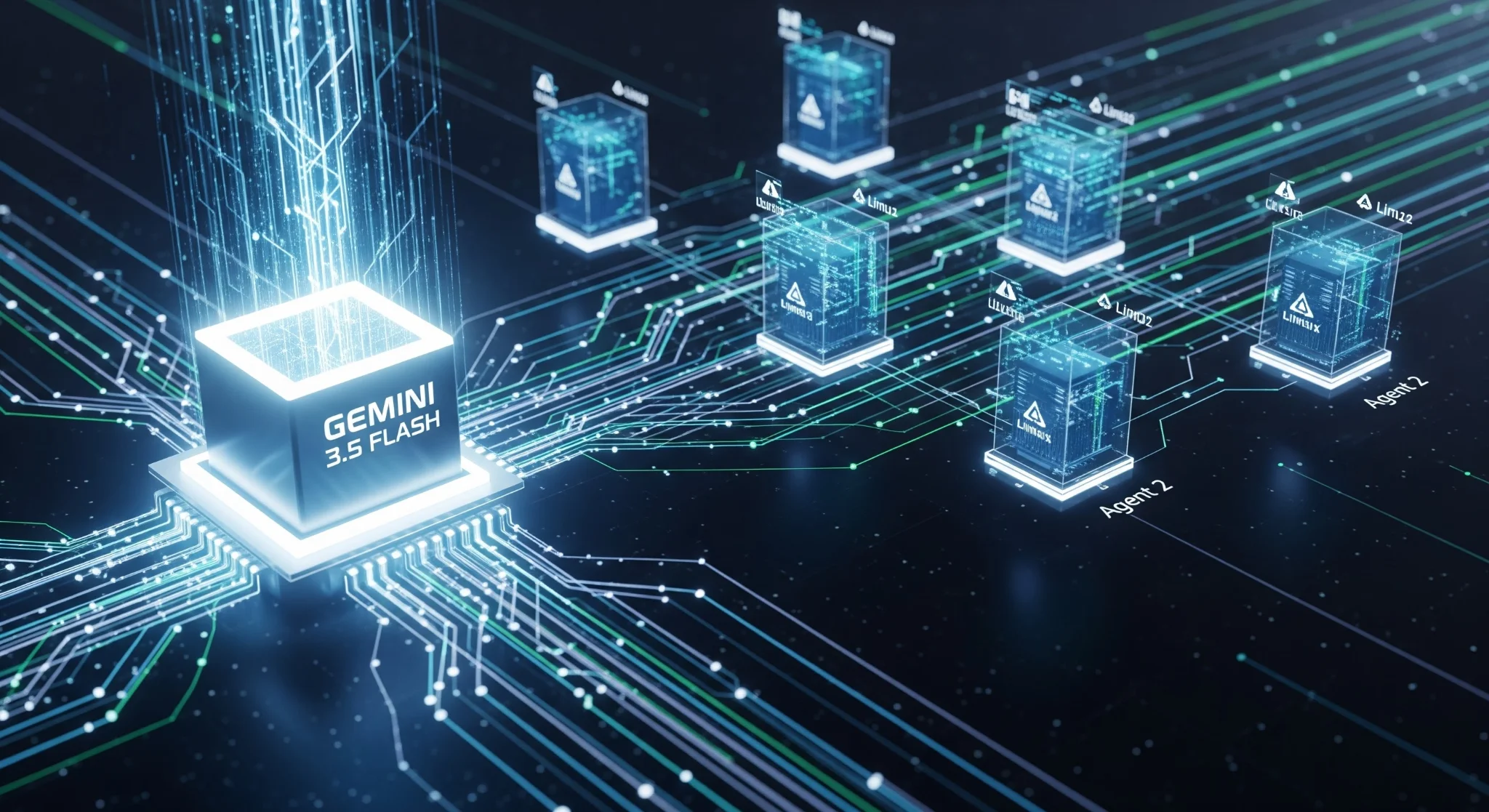
This level of concurrency requires incredible speed, which is why the platform is powered by Gemini 3.5 Flash. Google claims it hits 289 tokens per second (tps). For context, Claude Opus 4.7 sits at roughly 67 tps, and GPT-5.5 at 71 tps. This 4x speed advantage is what prevents multi-agent chains from bottlenecking.
The “Managed Agents” layer allows developers to spin up isolated Linux environments with a single API call. The AI can reason, use tools, and execute code within this persistent environment, remembering past context across sessions.
To prove the scale of this tech, Google’s Varun Mohan demoed the system building an entire operating system from scratch in 12 hours. It utilized 93 sub-agents, processed 2.6 billion tokens, and resulted in a kernel stable enough to run DOOM live on stage. For more on how Gemini 3.5 Flash compares to other frontier models, see our Best AI Tools for 2026 guide.
The Backlash: Why Developers Revolted
Despite the impressive tech, the rollout was an unmitigated disaster for active developers. The update was pushed automatically without an opt-in prompt. Users woke up to broken environments.
Here is a breakdown of the critical issues developers faced during the transition:
| Issue Area | Impact on Developers |
|---|---|
| Installation Conflicts | Antigravity 2.0 and Antigravity IDE (the legacy version) fought over the same directory, overwriting each other and corrupting workspace configurations |
| Loss of Visual Control | The traditional editor experience was gutted. Visual indicators for minor warnings were removed, leaving developers feeling “blind” to smaller bugs |
| Process Tracking Bugs | If a developer closed an app being tested, the chat interface would still register it as running and misdiagnose the closure as a malfunction, requiring manual process kills |
| The CLI Deadline | Google mandated that all users must migrate off the old Gemini CLI by June 18th, 2026, or the tool will cease processing requests entirely |
The response across developer communities was swift. Reddit threads filled with developers sharing workarounds, downgrade scripts, and alternatives like Cursor and GitHub Copilot. Google’s own forums were flooded with reports of corrupted projects and lost productivity.
This mirrors some of the earlier tensions we covered in our Hermes Agent AI analysis, where autonomous browser agents forced developers to rethink traditional debugging workflows.
Conclusion: Redefining the Developer
Google is clearly not competing on price. While Cursor costs $20/month, the recommended Antigravity Ultra plan is $100/month (with a massive $200/month Premium tier). Google is competing on infrastructure, betting that developers will pay a premium for deep integration with Firebase, Android, and Google Cloud.
The messy rollout of Antigravity 2.0 highlights a painful truth: Google is redefining the role of the software developer. The job is shifting from writing syntax to managing a fleet of autonomous agents. The technology is here, but as the backlash showed, the human workforce was not ready for the jump to happen overnight.
As AI-native development platforms accelerate, the winners will be those who adapt — not necessarily the best coders, but the best orchestrators of AI agents. The Antigravity 2.0 story is a preview of what happens when platform-level AI strategy collides with real-world developer readiness.
💡 Want more AI guides, tutorials, and industry analysis? Visit: SimpleAIGuide.tech
📚 Further Reading:
- Google I/O 2026 Full Breakdown — Gemini Omni Flash, Antigravity 2.0 & More
- Google I/O 2026 — Every Major AI Announcement Explained (Deep Dive)
- Hermes Agent AI — Autonomous Browser Agents for Developers
- Best AI Tools for 2026 — Ranked by Real ROI
- Andrej Karpathy Joins Anthropic — AI Job Disruption Analysis
- Titans Memory Architecture — The Future Beyond Transformers
Written by Simple AI Guide Team
We are a team of AI enthusiasts and engineers dedicated to simplifying artificial intelligence for everyone. Our goal is to help you leverage AI tools to boost productivity and creativity.
Personally Tested by Our Team
This article and all recommended tools were reviewed with real prompts, hands-on checks, and editorial QA before publishing.
Testing Methodology
We test each AI tool using standardized prompts across 5 categories: accuracy, speed, ease of use, value, and unique features.
Content Last Updated
Last reviewed and updated on May 27, 2026. We'll update again when new versions are released.
Discussion
Comments powered by Supabase
Continue Reading
Related Articles
The Google I/O 2026 Megadrop: Autonomous Agents, Multimodal World Models, and the Changing Fabric of the Web
Complete deep dive analysis of Google I/O 2026 — Gemini 3.5 Flash vs Claude Opus 4.7, Gemini Omni multimodal world model, Gemini Spark & Antigravity 2.0 autonomous agents, Universal Cart, AI-driven Search overhaul, AR glasses with SynthID, and the broader AI industry shakeup.
Read moreGoogle I/O 2026: The Day AI Transitioned from Predicting Text to Simulating Reality
Complete breakdown of Google I/O 2026: Gemini Omni Flash video generation, Antigravity 2.0 agentic framework, Gemini Spark 24/7 autonomous agents, Search reimagined with generative UI, Stitch/Flow creative tools, smart eyewear, and more.
Read moreGoogle I/O 2026: Every Major AI Announcement Explained — The Biggest 24 Hours in AI History
Complete breakdown of Google I/O 2026: Gemini 3.5 Flash, AI-powered Search redesign, Gemini Spark agents, Anti-Gravity 2.0, Google Flow, SynthID, Smart Glasses, and 16+ major AI announcements explained.
Read more