
AI in Cybersecurity 2026: Threat Detection, SOC Automation, and the Skills Gap Reshaping the Industry
On This Page
- 1. The Scale of the Problem: Why Traditional Cybersecurity Is Breaking
- The Alert Avalanche
- The Attacker Advantage
- 2. AI-Powered Threat Detection: Finding the Unknown
- Behavioural Analysis and Anomaly Detection
- Real-World Impact: Catching SolarWinds-Style Attacks
- Key AI Threat Detection Capabilities
- 3. SOC Automation: AI as the Analyst That Never Sleeps
- The Traditional SOC and Its Limitations
- AI-Powered SOAR: Security Orchestration, Automation and Response
- Mean Time to Detect and Respond
- 4. AI-Powered SIEM: Making Sense of the Data Tsunami
- Next-Generation SIEM Capabilities
- Leading AI-Powered SIEM Tools
- 5. Large Language Models in Cybersecurity: The New Analyst’s Assistant
- Log Analysis and Report Generation
- Threat Intelligence Summarisation
- Vulnerability Management
- 6. AI in Specific Security Domains
- Email Security and Phishing Detection
- Identity and Access Management
- Cloud Security
- Malware Analysis
- 7. The Cybersecurity Skills Gap: Why AI Is Not Optional
- AI as a Force Multiplier
- The New Skills That Matter
- 8. The Other Side: How Attackers Are Using AI Too
- AI-Enhanced Phishing
- Polymorphic Malware
- Automated Vulnerability Discovery
- The Implication for Defenders
- AI Cybersecurity Tools: Quick Reference Guide
- Where Cybersecurity AI Is Headed: The Next Three Years
- Autonomous Security Operations
- Proactive Threat Hunting at Machine Speed
- Converging AI Ecosystems
- Frequently Asked Questions
- How is AI used in cybersecurity?
- What is SOC automation?
- Can AI detect unknown threats?
- How big is the cybersecurity skills gap?
- Do attackers use AI?
- What are the best AI cybersecurity tools?
- Sources
Key Takeaways
- AI-powered threat detection uses behavioural analytics to identify unknown threats that signature-based systems miss
- SOAR platforms automate 70% of Tier 1 SOC analyst tasks, cutting MTTD/MTTR and saving $1.76M per breach on average
- 3.5 million cybersecurity positions remain unfilled globally — AI force multipliers are the most viable solution at scale
- LLMs transform log analysis, incident reporting, and threat intelligence summarisation from hours to minutes
- Attackers also use AI for phishing, polymorphic malware, and automated vulnerability discovery — AI defence is no longer optional
Cybersecurity has always been a battle of speed. Attackers move fast. Defenders have to move faster. For decades, that battle was fought with human expertise, manual log analysis, and rules-based detection systems that could only catch what they had already been told to look for. The problem is that the threat landscape has long since outgrown that approach.
Today, the average enterprise network generates millions of security events every single day. A mid-sized company running standard monitoring tools might see 10,000 alerts per day. A large enterprise can see ten times that. Human security teams — already stretched thin across a global skills shortage of more than 3.5 million unfilled cybersecurity positions — cannot keep up. And attackers know it.
Key Stat: There are currently more than 3.5 million unfilled cybersecurity positions worldwide. AI-powered tools are the most viable solution to bridging this gap at scale.
This guide breaks down exactly how AI is reshaping cybersecurity — from threat detection and SOC automation to next-gen SIEM tools and the skills gap. For more AI industry analysis, see our AI bubble analysis and best AI tools for 2026.
1. The Scale of the Problem: Why Traditional Cybersecurity Is Breaking
To appreciate why AI has become essential in cybersecurity, you first need to understand just how dramatically the threat environment has changed.
The Alert Avalanche
Modern enterprise networks produce an almost incomprehensible volume of security data. Every firewall request, every login attempt, every file access, every API call, every DNS query generates a log entry. A typical Security Operations Centre receives between 10,000 and 100,000 security alerts per day. Studies consistently show that the majority of those alerts are false positives — genuine threats buried in a mountain of noise.
The result is a phenomenon security professionals call alert fatigue. Analysts, overwhelmed by volume and desensitised by constant false positives, begin to miss the real threats. In several high-profile breaches — including the SolarWinds attack and the Target data breach — the initial indicators of compromise were visible in logs that were simply not investigated in time. Not because the data wasn’t there. Because there was too much data, and too few people to review it.
The Attacker Advantage
Attackers have become significantly more sophisticated. Nation-state threat actors use advanced persistent threat (APT) techniques designed specifically to evade signature-based detection. Criminal ransomware groups offer Ransomware-as-a-Service (RaaS). And AI tools are increasingly available to attackers too — used to craft more convincing phishing emails and generate polymorphic malware.
The Core Problem: Traditional security tools catch known threats. AI-powered security can identify unknown threats by detecting anomalous behaviour — catching attacks that have never been seen before.
2. AI-Powered Threat Detection: Finding the Unknown
The most transformative application of AI in cybersecurity is threat detection — specifically, the ability to identify threats that have never been seen before.
Behavioural Analysis and Anomaly Detection
Traditional intrusion detection systems (IDS) work by matching network traffic against a database of known attack signatures. AI-powered threat detection takes a fundamentally different approach. Rather than looking for known bad patterns, it builds a model of what normal looks like — and then flags anything that deviates from that baseline. This is called behavioural analytics or anomaly detection.
A machine learning model trained on an organisation’s network traffic learns what normal user behaviour looks like: which systems communicate with which other systems, at what times, at what volumes, using which protocols. When something deviates — a user account accessing files at 3 AM that it has never accessed before — the AI flags it as potentially anomalous, even if no known attack signature is present.
Real-World Impact: Catching SolarWinds-Style Attacks
The SolarWinds supply chain attack of 2020 is a masterclass in why signature-based detection fails. Because the malicious code was distributed as a signed, legitimate software update, it passed through signature-based security tools without triggering alerts for months.
Behavioural AI systems, by contrast, would have been looking at the downstream behaviour — the unusual outbound connections, the atypical data staging, the lateral movement patterns — rather than the signature of the initial infection vector. Several cybersecurity vendors have demonstrated that behavioural AI could have detected SolarWinds-style attacks at the lateral movement stage.
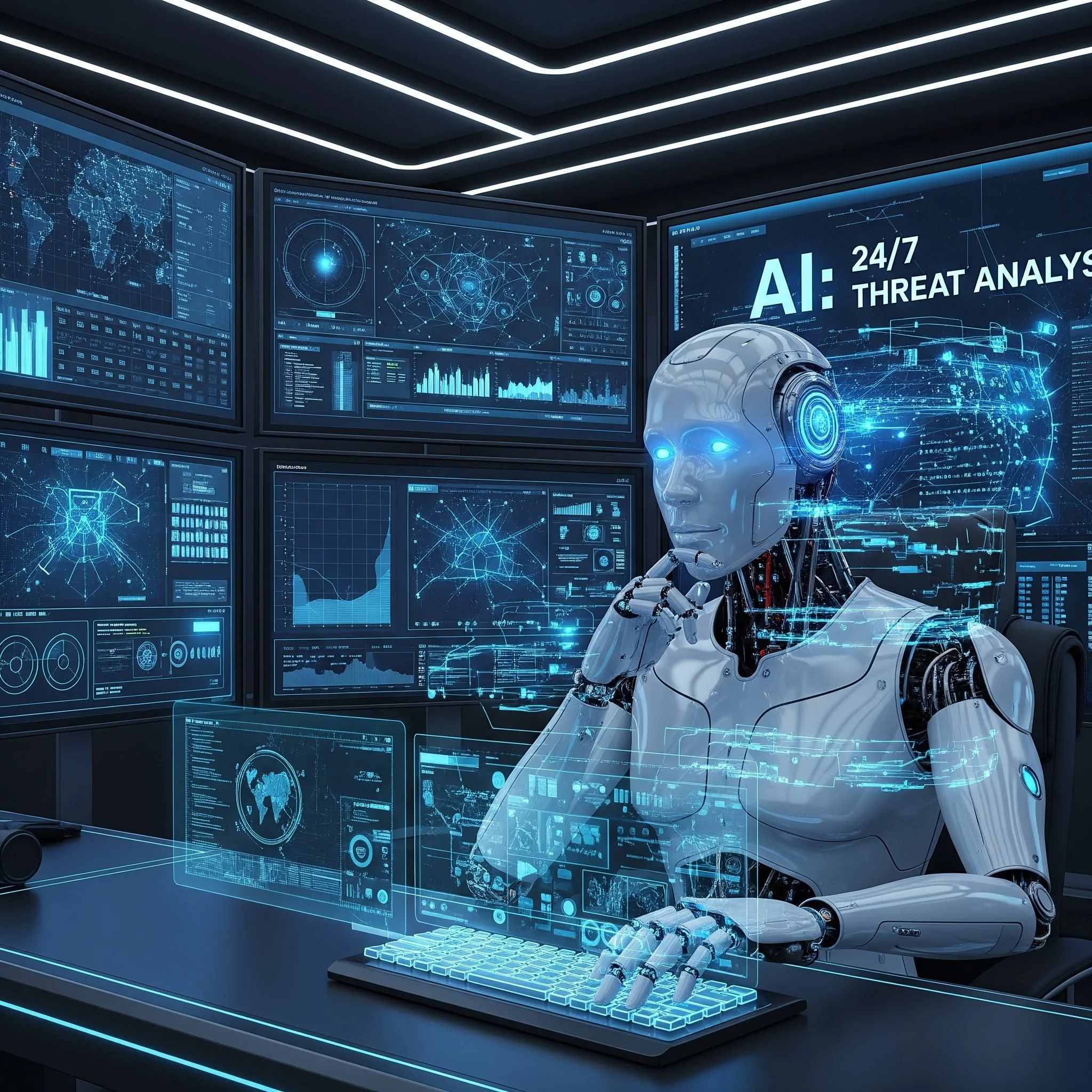
Key AI Threat Detection Capabilities
- User and Entity Behaviour Analytics (UEBA) — detecting compromised accounts by flagging behavioural deviations
- Network Traffic Analysis (NTA) — identifying C2 communications, data exfiltration, and lateral movement
- Endpoint Detection and Response (EDR) — real-time monitoring of endpoint behaviour for signs of compromise
- File integrity monitoring — detecting unauthorised changes to critical system files
- Zero-day threat detection — identifying novel malware based on behavioural characteristics, not signatures
3. SOC Automation: AI as the Analyst That Never Sleeps
The Security Operations Centre is the nerve centre of an organisation’s cybersecurity defence — and it is also the part most dramatically transformed by AI.
The Traditional SOC and Its Limitations
A traditional SOC operates on a tiered model. Tier 1 analysts monitor alerts and perform initial triage. Tier 2 analysts perform deeper investigation. Tier 3 analysts handle complex incidents and threat hunting. The model has serious limitations: it is slow, expensive, dependent on analyst availability, and critically vulnerable to alert fatigue.
A significant proportion of Tier 1 analyst time — some studies suggest up to 70% — is spent on repetitive, low-value tasks. These are exactly the tasks AI is best suited to automate.
AI-Powered SOAR: Security Orchestration, Automation and Response
SOAR platforms use AI and automation to handle the high-volume tasks that previously consumed Tier 1 analyst bandwidth. When an alert fires, a SOAR platform can automatically:
- Collect and correlate relevant log data from across the environment
- Query threat intelligence feeds to determine if known indicators are present
- Enrich the alert with context — asset criticality, user access level, geographic location
- Apply pre-built decision logic to determine likely severity and category
- Execute an automated response — blocking an IP, isolating an endpoint
- Generate a detailed incident report and escalate only if required
What previously took a Tier 1 analyst 20–40 minutes per alert can be completed in seconds.
Mean Time to Detect and Respond
The two most important metrics in cybersecurity are Mean Time to Detect (MTTD) and Mean Time to Respond (MTTR) . IBM’s Cost of a Data Breach Report found that organisations with fully deployed security AI and automation had an average cost of a data breach that was $1.76 million lower — and detected and contained breaches an average of 108 days faster.
4. AI-Powered SIEM: Making Sense of the Data Tsunami
Security Information and Event Management (SIEM) platforms are the data aggregation backbone of enterprise security. Traditional SIEM tools have been powerful but challenging to operate — requiring extensive tuning and generating enormous volumes of alerts.
The integration of AI and machine learning into SIEM platforms is fundamentally changing that experience.
Next-Generation SIEM Capabilities
- Dynamic baselining — continuously updating what normal looks like without manual rule updates
- Automated threat hunting — proactively searching for indicators of compromise
- Natural language querying — searching log data using plain English
- Contextual alert prioritisation — ranking alerts by actual risk level
- Automated investigation timelines — reconstructing full incident sequences automatically
Leading AI-Powered SIEM Tools
Several platforms lead AI-powered security operations. Microsoft Sentinel uses machine learning across the security ecosystem. Splunk applies AI to pattern recognition across massive datasets. IBM QRadar uses AI to correlate events across hybrid cloud. CrowdStrike Falcon combines endpoint telemetry with AI-driven threat intelligence.
What unites these platforms is the shift from reactive, rule-based detection to proactive, intelligence-driven security.
5. Large Language Models in Cybersecurity: The New Analyst’s Assistant
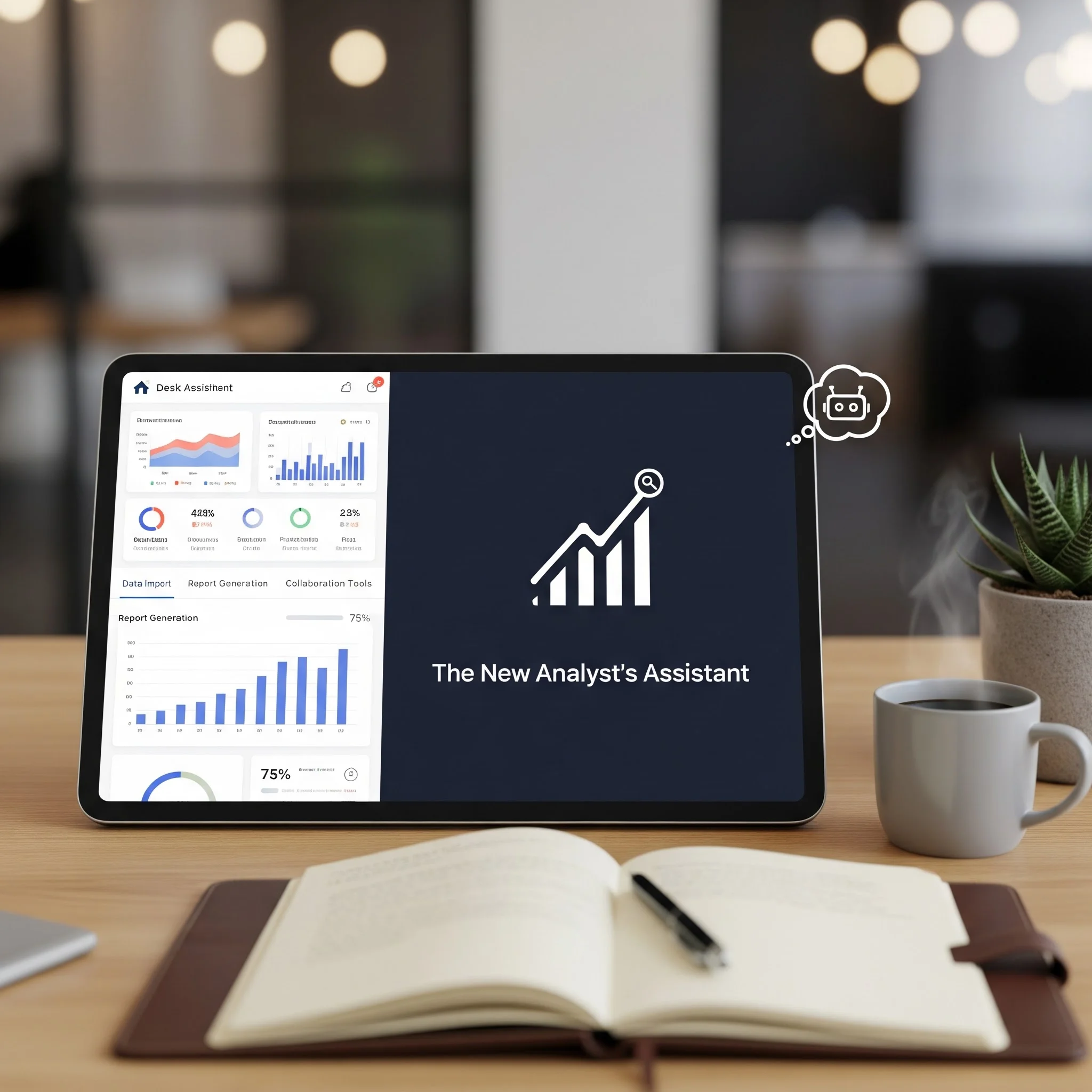
Beyond machine learning for detection and automation for response, LLMs like GPT-4, Gemini, and Claude are creating an entirely new category of capability: interacting with complex security data in plain language.
Log Analysis and Report Generation
A security analyst can now take raw network logs, provide it to an LLM, and receive a structured, plain-English analysis that identifies key events, reconstructs the attack timeline, and recommends remediation steps. What previously took 2–3 hours can be completed in minutes.
Threat Intelligence Summarisation
LLMs can ingest and summarise the enormous volume of daily threat intelligence content — vendor advisories, government bulletins, dark web reports — extracting the indicators most relevant to a specific organisation.
Vulnerability Management
When a new CVE is disclosed, LLMs accelerate assessment: explaining the vulnerability, identifying affected systems, and generating remediation guidance tailored to the organisation’s technology stack.
“AI doesn’t replace the security analyst. It removes the parts of the job that drain the analyst’s time and energy, so they can focus on the judgement calls that actually require human expertise.” — CrowdStrike
6. AI in Specific Security Domains
Email Security and Phishing Detection
Email remains the most common initial attack vector. AI-powered email security tools analyse linguistic patterns, communication graphs, and behavioural signals to identify sophisticated phishing attempts that pass all traditional filters. Microsoft Defender for Office 365 and Google’s Gmail security both use AI to detect impersonation attacks.
Identity and Access Management
AI-powered IAM systems apply continuous behavioural analysis to identity activity, detecting compromised credentials and insider threats by flagging deviations from established user patterns.
Cloud Security
AI-powered Cloud Security Posture Management (CSPM) tools continuously scan cloud configurations for misconfigurations, prioritising findings by actual risk level.
Malware Analysis
Machine learning models classify malware samples and identify families within seconds. LLMs generate plain-English summaries, making advanced analysis accessible to all analysts.
7. The Cybersecurity Skills Gap: Why AI Is Not Optional
The cybersecurity industry faces a structural talent crisis. The global shortage stands at over 3.5 million unfilled positions, growing year over year.
AI as a Force Multiplier
AI does not solve the skills gap by replacing security professionals. It makes each professional dramatically more productive. A team of five AI-augmented analysts can deliver security outcomes that previously required fifteen. For organisations that cannot hire fifteen analysts, that is the difference between having functional security operations and not.
The New Skills That Matter
The most in-demand cybersecurity professionals in 2026 are those who can:
- Configure and tune AI security tools to their organisation’s environment
- Interpret and critically evaluate AI-generated analysis
- Design detection logic that goes beyond what AI can generate autonomously
- Communicate security risk clearly using AI-generated reports as a starting point
- Understand adversarial AI and defend against AI-powered attacks
8. The Other Side: How Attackers Are Using AI Too
AI is not exclusively a defensive tool. Understanding how attackers deploy AI is essential for preparing defences.
AI-Enhanced Phishing
AI-generated phishing emails can be grammatically flawless, contextually convincing, and personalised using public data — allowing attackers to generate thousands of highly targeted spear-phishing emails at minimal cost.
Polymorphic Malware
AI enables polymorphic malware that rewrites itself with each execution, making signature-based detection ineffective.
Automated Vulnerability Discovery
AI tools accelerate identifying vulnerabilities in target systems, reducing the window between disclosure and exploitation.
The Implication for Defenders
The fact that attackers deploy AI makes AI-powered defence not a competitive advantage but a baseline requirement. Organisations relying exclusively on traditional rule-based tools against AI-enhanced attacks operate at a structural disadvantage.
AI Cybersecurity Tools: Quick Reference Guide
| Tool / Platform | Primary Function | AI Capability | Best For |
|---|---|---|---|
| Microsoft Sentinel | SIEM / SOAR | ML threat detection, Copilot NL queries | Enterprise / Azure environments |
| CrowdStrike Falcon | EDR / Threat Intelligence | AI behavioural analysis, Charlotte AI assistant | Endpoint protection at scale |
| Splunk Enterprise Security | SIEM / Log Analysis | ML anomaly detection, AI-driven risk scoring | Large-scale log analytics |
| IBM QRadar | SIEM / Threat Detection | AI correlation, hybrid cloud visibility | Hybrid / multi-cloud environments |
| Darktrace | Network / AI Security | Self-learning AI, autonomous response | Autonomous threat containment |
| SentinelOne | EDR / XDR | AI Purple AI assistant, automated remediation | Unified endpoint + cloud security |
| Google Chronicle | SIEM / Threat Intelligence | Gemini AI integration, petabyte-scale analysis | Google Cloud environments |
Where Cybersecurity AI Is Headed: The Next Three Years
Autonomous Security Operations
The logical endpoint of SOC automation is security operations that can detect, investigate, contain, and remediate the majority of incidents without human intervention — with humans involved only for decisions requiring organisational judgement.
Proactive Threat Hunting at Machine Speed
Tomorrow’s tools will continuously hunt for indicators of compromise across the environment before incidents occur, generating and testing threat hypotheses at machine speed.
Converging AI Ecosystems
AI is accelerating the consolidation of fragmented security tools into integrated platforms that share telemetry, correlate intelligence, and present a unified operational picture.
The organisations that will be most secure in 2027 are not those that spend the most on security. They are those that most effectively combine human expertise with AI capability.
For more on AI transforming industries, see our Google I/O 2026 recap, AI bubble market analysis, and best AI tools directory.
Frequently Asked Questions
How is AI used in cybersecurity?
AI is used for threat detection via behavioural analytics, SOC automation through SOAR platforms, next-gen SIEM analysis, LLM-based log analysis, phishing detection, malware classification, and cloud security posture management.
What is SOC automation?
SOC automation uses AI-powered SOAR platforms to automate repetitive Tier 1 security tasks — alert triage, threat intelligence correlation, and automated response — reducing MTTD/MTTR dramatically.
Can AI detect unknown threats?
Yes. Unlike signature-based systems that only catch known threats, AI-powered behavioural analytics detects anomalies based on deviations from normal baselines, catching novel and zero-day attacks.
How big is the cybersecurity skills gap?
Over 3.5 million cybersecurity positions are unfilled globally. AI force multipliers are the most viable solution, allowing small teams to achieve outcomes that previously required much larger teams.
Do attackers use AI?
Yes. Attackers use AI for phishing generation, polymorphic malware, and automated vulnerability discovery. This makes AI-powered defence a baseline requirement rather than a competitive advantage.
What are the best AI cybersecurity tools?
Leading platforms include Microsoft Sentinel, CrowdStrike Falcon, Splunk, IBM QRadar, Darktrace, and various SOAR and EDR platforms with integrated AI capabilities.
Sources
- IBM Cost of a Data Breach Report
- CrowdStrike Global Threat Report
- SANS Institute: AI in Cybersecurity
- Microsoft Sentinel Documentation
- Reuters: SolarWinds Cyber Attack
- ISC2 Cybersecurity Workforce Study
Written by Simple AI Guide Team
We are a team of AI enthusiasts and engineers dedicated to simplifying artificial intelligence for everyone. Our goal is to help you leverage AI tools to boost productivity and creativity.
Personally Tested by Our Team
This article and all recommended tools were reviewed with real prompts, hands-on checks, and editorial QA before publishing.
Testing Methodology
We test each AI tool using standardized prompts across 5 categories: accuracy, speed, ease of use, value, and unique features.
Content Last Updated
Last reviewed and updated on May 21, 2026. We'll update again when new versions are released.
Discussion
Comments powered by Supabase
Continue Reading
Related Articles
Is the AI Bubble About to Pop? The Infrastructure Crisis Wall Street Isn't Talking About
Bloomberg reports nearly 50% of US AI data centers face delays due to electrical equipment shortages. Analysis of the AI bubble, infrastructure crisis, market risks, and what it means for investors.
Read moreDeepSeek TUI: The Open-Source Rust AI Coding Agent That Could Replace Claude Code
DeepSeek TUI is a Rust-based open-source AI coding agent with 1M token context, NVIDIA NIM free tier, and sandboxed execution. Full setup guide, benchmarks vs Claude Code, and real-world use cases.
Read moreGoogle I/O 2026: Every Major AI Announcement Explained — The Biggest 24 Hours in AI History
Complete breakdown of Google I/O 2026: Gemini 3.5 Flash, AI-powered Search redesign, Gemini Spark agents, Anti-Gravity 2.0, Google Flow, SynthID, Smart Glasses, and 16+ major AI announcements explained.
Read more