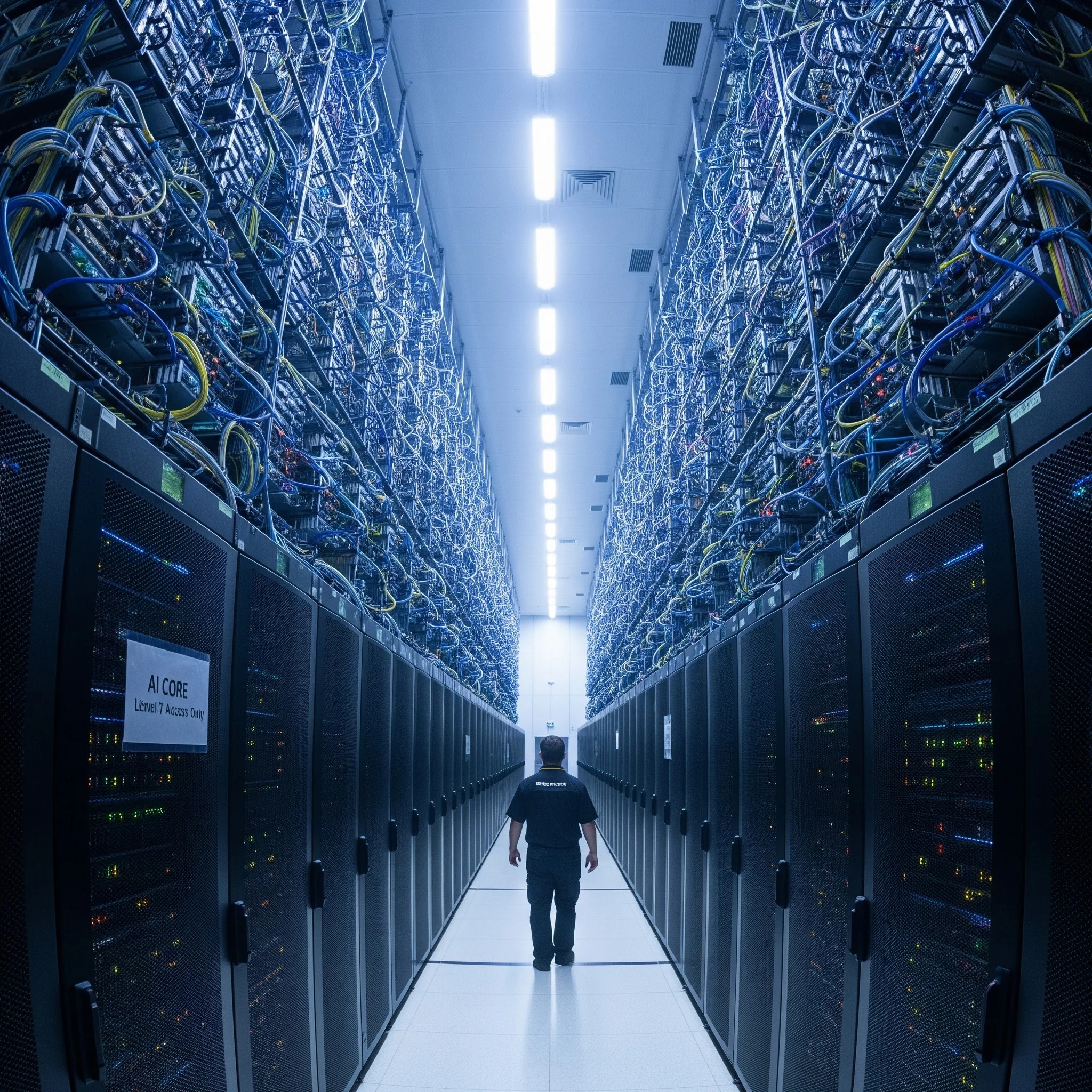
Is the AI Bubble About to Pop? The Infrastructure Crisis Wall Street Isn't Talking About
On This Page
- 1. The Physical Reality of AI: These Are Not Small Server Rooms
- What a Modern AI Data Center Actually Needs
- 2. The Bloomberg Bombshell: Half of AI Data Centers May Be Delayed
- The Perfect Storm of Competing Demand
- 3. How AI Took Over the Stock Market — and Why That’s Dangerous
- The Concentration Risk
- Priced for Perfection
- 4. The Four Risks That Could Pop the AI Bubble
- Risk 1: Infrastructure Cannot Scale Fast Enough
- Risk 2: Electricity Costs and Community Resistance
- Risk 3: Regulation Is Coming
- Risk 4: Winner-Takes-All Consolidation
- 5. Jeff Bezos Explains the Bubble Mechanic
- What Bezos Got Right
- 6. Lessons From History: Every Boom Has Had Its Breaking Point
- The Dot-Com Bubble (1995–2001)
- The Railroad Mania (1840s)
- The Parallel to AI Today
- 7. What a Slowdown Would Actually Mean for Ordinary People
- Pension Funds and Retirement Accounts
- Public Markets and Investor Confidence
- The Broader Economy
- 8. The Case for Optimism: Why AI Is Still a Genuine Revolution
- What Will Survive the Correction
- The Distinction That Matters
- Risk Snapshot: AI Bubble Warning Indicators
- Final Verdict: Not a Pop — But a Reckoning Is Coming
- What You Should Do With This Information
- Frequently Asked Questions
- Is the AI bubble about to pop?
- What did the Bloomberg report find about AI data centers?
- Why are transformers the bottleneck for AI infrastructure?
- How much of the S&P 500 is AI stocks?
- What did Jeff Bezos say about AI investment?
- What lessons does the dot-com bubble offer for AI?
- Sources
Key Takeaways
- Bloomberg reports nearly 50% of planned US data centers in 2026 face delays or cancellation due to electrical equipment shortages
- AI and tech stocks now account for nearly 50% of the S&P 500's total valuation — creating dangerous concentration risk
- Transformer lead times of 12-52 weeks are the critical chokepoint, with demand competing against EV charging and grid upgrades
- Jeff Bezos warns AI is a 'horizontal enabling layer' but distinguishes genuine transformation from inflated valuations
- Historical parallels to the dot-com bubble (78% Nasdaq decline) suggest a significant repricing may be ahead
For the past three years, the narrative around artificial intelligence has been built on a simple, seductive premise: AI is the next gold rush, the money will keep flowing, and whoever builds fastest will win. Investors have poured trillions of dollars into AI companies. Governments have pledged national AI strategies. Wall Street has pushed AI and tech stocks to account for nearly half of the entire S&P 500’s total valuation. The story has been treated as settled: AI will keep growing, and there is no ceiling in sight.
But something has started to crack underneath the hype. And according to a bombshell Bloomberg report, the cracks are not in the software, not in the chips, and not in public demand for AI tools. The problem is far more fundamental than that. America may not be able to physically power the AI boom fast enough.
Key Stat: Bloomberg reports nearly 50% of planned US data centers this year are expected to be delayed or cancelled due to electrical equipment shortages.
This guide breaks down the full picture: what’s actually happening with AI infrastructure, why financial markets are dangerously exposed, what history tells us about technology bubbles, and what it all means for your money, your business, and the future of AI. For more AI industry analysis, see our AI news coverage, cybersecurity AI guide, and Google I/O 2026 recap.
1. The Physical Reality of AI: These Are Not Small Server Rooms
To understand why the infrastructure problem is so serious, you first need to understand the physical scale of modern AI data centers. Most people picture server rooms when they think of AI infrastructure — rows of blinking computers in a climate-controlled basement. That image is decades out of date.
Today’s hyperscale AI data centers are more comparable to small cities than office buildings. They stretch across vast tracts of land, contain multiple enormous warehouse-scale buildings, operate under heavy security, require constant industrial-grade cooling, and consume electricity at a scale that rivals entire metropolitan areas.
What a Modern AI Data Center Actually Needs
To bring a large AI data center online, developers need every single one of the following components working simultaneously:
- Land — often hundreds of acres in areas with reliable grid access
- Buildings — purpose-built, climate-controlled warehouse structures
- Water — massive cooling systems that can consume millions of gallons
- Power lines and grid connections — new transmission infrastructure
- Transformers — specialized electrical equipment with 12–52 week lead times
- Switchgear — electrical panels and control systems, also under severe supply pressure
- Backup generators and batteries — for uninterrupted operation
- Permits — environmental, zoning, utility, and construction approvals that can take years
If any single one of these components is unavailable, the entire project stalls. You can have the land, the buildings, the servers, and the billions in investment capital — but without the transformers, the facility cannot go live. And right now, transformers are the critical chokepoint.
Why Transformers? Transformers are highly specialized, custom-built electrical devices. They cannot be mass-produced quickly. Lead times have stretched to 1–4 years in some cases, driven by simultaneous demand from data centers, EV charging infrastructure, and grid upgrades.
2. The Bloomberg Bombshell: Half of AI Data Centers May Be Delayed
The Bloomberg report on this issue is not speculative. It is based on industry data, developer interviews, and supply chain analysis. The headline finding is stark: almost half of the data centers planned in the United States for this year are expected to be delayed or cancelled.
The Perfect Storm of Competing Demand
The transformer and switchgear shortage is not being caused by AI alone. The same electrical infrastructure needed for data centers is also being demanded simultaneously by:
- Electric vehicle charging networks — millions of new charging stations require grid-level transformers
- Heat pump installations — the shift from gas to electric home heating is driving residential grid upgrades
- General grid modernization — ageing infrastructure across the US requires large-scale replacement
- Renewable energy projects — solar and wind farms require substantial electrical equipment to connect to the grid
AI data centers are now competing against all of these projects for the same limited pool of electrical equipment. And because transformers are bespoke, heavy industrial products — not consumer electronics — supply simply cannot be ramped up quickly to meet the surge in demand. For more on AI’s energy impact, see our AI news analysis.
“The electrical equipment needed to bring facilities online is hard to come by. It’s already creating delays and forcing developers to get creative with how they source equipment.” — Bloomberg
The result is a logjam that is real, measurable, and already affecting projects that have already secured financing. This is not a theoretical future risk. It is happening right now.
3. How AI Took Over the Stock Market — and Why That’s Dangerous
To understand why the infrastructure problem matters far beyond the technology industry, you need to understand just how dominant AI and tech stocks have become in global financial markets.
AI-related companies now account for close to half of the S&P 500’s total market capitalization. To put that in perspective: the S&P 500 is an index of the 500 largest publicly traded companies in America, spanning every industry from healthcare and energy to retail and financial services. For AI and tech to represent nearly half of that index’s total value is extraordinary.
The Concentration Risk
Less than three years ago, tech and AI-related stocks accounted for roughly a quarter of the S&P 500’s total valuation. Today, that figure has roughly doubled, approaching 50%. This means the health of the entire US stock market is now heavily dependent on a relatively small number of companies continuing to perform exceptionally well.
This concentration creates what financial analysts call systemic risk. When the gains of an entire market are driven by a handful of companies, the market becomes fragile. If those companies disappoint — even slightly, even temporarily — the consequences can ripple far beyond the companies themselves.
What’s at Stake: Pension funds, retirement accounts (401Ks), index funds, and institutional portfolios are all heavily exposed to AI stocks through their S&P 500 holdings. A significant correction in AI valuations would not just hurt tech investors — it could affect millions of ordinary people.
Priced for Perfection
When valuations reach the levels we’re seeing in AI stocks today, companies are not just priced to do well. They are priced to do everything right, all at once, with no delays, no setbacks, and no disappointments. Analysts call this “priced for perfection.”
That means the market is currently assuming that AI demand will keep growing, that data centers will come online on schedule, that power infrastructure will be available, that regulation will not significantly disrupt business models, and that the leading AI companies will continue to generate extraordinary profits. If any of those assumptions proves wrong — and the Bloomberg data suggests at least one already is — the repricing can be sudden and severe.
4. The Four Risks That Could Pop the AI Bubble

While the infrastructure crisis is the most immediate and concrete threat to AI market valuations, it is not the only one. Four distinct risk categories are converging simultaneously.
Risk 1: Infrastructure Cannot Scale Fast Enough
As detailed above, the physical infrastructure needed to power AI — electrical equipment, grid capacity, water access, permits — is not keeping pace with investment intentions. Nearly half of planned US data centers this year face delays or cancellation. This directly reduces the revenue capacity of AI companies who need these facilities to serve customers.
Risk 2: Electricity Costs and Community Resistance
AI data centers are making electricity consumption a front-page political issue. In many US states, communities near proposed data center sites are organizing opposition on the grounds of noise, water use, visual impact, and the pressure that massive new electrical loads place on local grid infrastructure. In some cases, utility companies are being forced to choose between serving residential customers and accommodating the enormous power demands of new AI facilities.
Risk 3: Regulation Is Coming
Governments around the world are increasingly turning their attention to AI regulation. The European Union has already passed comprehensive AI legislation. In the United States, both political parties have expressed concerns about AI — for different reasons, but with overlapping legislative interest. Regulatory frameworks that didn’t exist two years ago are now being written.
For companies whose valuations assume unimpeded growth in every jurisdiction, regulatory friction represents a material risk that is not currently priced in by most investors.
Risk 4: Winner-Takes-All Consolidation
In every major technology wave, the eventual winners are a small number of platforms that consolidate the market around themselves. For every Google that emerged from the internet era, hundreds of search engines, portals, and web services disappeared entirely. The same pattern is likely in AI: a small number of foundational models and platforms will dominate, while the majority of AI startups will fail.
Historical Context: During the dot-com era, the internet itself was real and transformative — but that did not prevent the Nasdaq from falling 78% from its peak. The technology surviving does not guarantee the valuations surviving.
5. Jeff Bezos Explains the Bubble Mechanic
One of the clearest explanations of how AI investment has moved into bubble territory came not from a financial regulator or central banker, but from Amazon founder Jeff Bezos.
“People get very excited, as they are today about artificial intelligence. Every experiment gets funded. Every company gets funded — the good ideas and the bad ideas. And investors have a hard time, in the middle of this excitement, distinguishing between the good ideas and the bad ideas.” — Jeff Bezos
This is the precise dynamic we are observing in AI today. Investment capital has flowed not just to companies with proven business models and clear paths to profitability, but to almost anything connected to the AI narrative. The word “AI” in a company’s pitch deck has been sufficient to unlock funding rounds that would have been scrutinized much more carefully in a more sober market environment. For perspective on which AI tools are actually delivering value, see our tested AI tools review.
What Bezos Got Right
Crucially, Bezos did not suggest that AI is unimportant or that the excitement is entirely misplaced. He described AI as “a horizontal enabling layer” — a technology so broad and foundational that it will affect every company in every industry, from manufacturing to hospitality to consumer products.
But he drew a sharp distinction between AI being genuinely transformational — which he clearly believes it is — and every AI investment being a good one. The two are not the same thing. And conflating them is precisely how bubbles form.
The internet was real. Railroads were real. The automobile was real. None of that prevented the speculative crashes that accompanied each of those waves of innovation.
6. Lessons From History: Every Boom Has Had Its Breaking Point
The current AI moment is not without historical precedent. Across the past two centuries, transformative technologies have generated investment booms that ultimately overshot reality before settling into sustainable long-term growth.
The Dot-Com Bubble (1995–2001)
The internet was — and remains — one of the most genuinely transformative technologies in human history. And yet, between March 2000 and October 2002, the Nasdaq Composite Index fell 78% from its peak. Companies with no revenue, no path to profitability, and sometimes no product at all had been valued in the billions. When the correction came, it was swift and indiscriminate.
The Railroad Mania (1840s)
When railroads transformed 19th-century economies, the investment speculation that accompanied them was intense. Land values along proposed rail routes soared. Railroad company stocks were bid to extraordinary multiples. When the inevitable rationalisation came, thousands of companies failed, fortunes were lost, and the industry was left to a much smaller number of survivors.
The Parallel to AI Today
AI may well be as transformative as the internet or the railroad — perhaps more so. But in every historical case, the gap between “this technology will change the world” and “every company attached to this technology will reward its investors” has been enormous.
7. What a Slowdown Would Actually Mean for Ordinary People
This analysis is not purely academic. If AI valuations correct significantly, the consequences would not be limited to venture capital funds and hedge funds.
Pension Funds and Retirement Accounts
Most index-based retirement accounts and pension funds hold significant exposure to S&P 500 companies. With AI and tech representing close to half of that index’s total value, a significant correction in AI stocks would reduce the value of retirement savings for millions of Americans. Geoffrey Hinton has also warned about broader AI risks — see our Hinton AI warning coverage.
Public Markets and Investor Confidence
Markets run on confidence as much as fundamentals. When a single narrative — “AI will keep growing forever” — becomes so dominant that it accounts for nearly half of the market’s total value, a loss of confidence in that narrative can trigger self-reinforcing selling.
The Broader Economy
A significant market correction driven by AI disappointment would also affect corporate investment decisions, technology employment, venture capital availability, and consumer confidence.
Important Note: None of this means a crash is certain or imminent. It means the risks are real, are currently underappreciated by mainstream financial media, and deserve serious consideration from anyone with financial exposure to AI-related assets.
For more on the current AI landscape, see our best AI tools for 2026 and AI industry news.
8. The Case for Optimism: Why AI Is Still a Genuine Revolution
Having laid out the risks clearly and honestly, it is equally important to be clear about what is not being argued here. This analysis does not suggest that AI is a fraud. It does not suggest that AI tools are useless. And it does not suggest that every AI company is headed for collapse.
AI is real. The productivity gains it enables are real. The transformation of industries it is beginning to drive is real. Jeff Bezos is right that AI is a horizontal enabling layer — a technology that will affect every company in every sector of the economy, ultimately raising quality and productivity across the board.
What Will Survive the Correction
The companies most likely to endure through whatever correction may come are those with:
- Genuine, defensible technology advantages that are difficult to replicate
- Clear, measurable paths to profitability rather than speculative future revenue
- Access to the physical infrastructure — power, land, grid connections — needed to scale
- Diversified revenue streams that are not entirely dependent on one AI application
- Strong regulatory relationships and a track record of responsible AI deployment
The Distinction That Matters
The key insight is the one Bezos offered: AI being real and transformational does not mean every AI investment is good. The technology will survive. Many of the valuations will not.
Risk Snapshot: AI Bubble Warning Indicators
| Risk Factor | Current Status | Severity |
|---|---|---|
| Data center delays | ~50% of 2025 projects affected | ⚠️ High |
| Transformer shortage | 1–4 year lead times | ⚠️ High |
| AI stock concentration | ~50% of S&P 500 value | ⚠️ High |
| Regulatory risk | EU live, US developing | 🟡 Medium |
| Community opposition | Growing in multiple states | 🟡 Medium |
| AI startup consolidation | Already underway | 🟡 Medium |
| AI demand being real | Confirmed and growing | ✅ Positive |
Final Verdict: Not a Pop — But a Reckoning Is Coming
So, is the AI bubble about to pop? The honest answer is: it depends on how you define “pop.” If you mean AI will become irrelevant overnight, the technology will be abandoned, and every AI company will go to zero — no. That is not what the evidence suggests.
But if you mean that the valuations assigned to AI companies today reflect assumptions that are already proving impossible to meet — unlimited infrastructure growth, zero regulatory friction, every company a winner, and perfect execution across the board — then the answer is yes. A reckoning is coming, and the Bloomberg data on infrastructure delays suggests it may already be beginning.
The most likely scenario, based on historical precedent and current evidence, is a significant repricing of AI assets as reality asserts itself against expectation. Some companies will survive and thrive. Many will not. And the infrastructure constraints around electricity and electrical equipment will slow the AI rollout in ways that markets have not yet fully priced.
What comes after the repricing may well be the most genuinely productive period in AI’s history — when the speculation clears, the real builders remain, and the technology gets deployed where it actually creates durable value. But getting there may require passing through a period of uncomfortable market correction first.
What You Should Do With This Information
- Do not dismiss AI as a technology — it is genuinely transformational
- Do scrutinize AI investments carefully, distinguishing hype from durable business value
- Review your portfolio’s exposure to AI-concentrated indices if you have a low risk tolerance
- Pay attention to infrastructure news — energy, grid capacity, and data center timelines are leading indicators
- Follow regulation closely — it will arrive, and it will reshape which AI business models are viable
For deeper analysis, explore our AI economy coverage and learn how the best AI tools are navigating these challenges.
Frequently Asked Questions
Is the AI bubble about to pop?
A complete collapse is unlikely, but a significant repricing is probable. Infrastructure constraints, regulatory pressure, and extreme market concentration suggest current valuations reflect assumptions that are already proving unrealistic.
What did the Bloomberg report find about AI data centers?
Bloomberg reported that nearly 50% of planned US data centers this year face delays or cancellation due to severe shortages of electrical equipment like transformers and switchgear.
Why are transformers the bottleneck for AI infrastructure?
Transformers are custom-built electrical devices with 12–52 week lead times. They face simultaneous demand from AI data centers, EV charging networks, heat pump installations, grid modernization, and renewable energy projects.
How much of the S&P 500 is AI stocks?
AI and tech-related companies now account for close to 50% of the S&P 500’s total market capitalization, up from roughly 25% three years ago — creating significant concentration risk.
What did Jeff Bezos say about AI investment?
Bezos warned that during periods of technological excitement, “every experiment gets funded” and investors struggle to distinguish good ideas from bad ones — a classic bubble dynamic.
What lessons does the dot-com bubble offer for AI?
The Nasdaq fell 78% from its peak despite the internet being genuinely transformative. The technology surviving did not protect investors from massive losses — a cautionary parallel for AI today.
Sources
- Bloomberg: AI Data Center Infrastructure Crisis
- Jeff Bezos Interview on AI Investment
- S&P 500 Sector concentration analysis
- US Department of Energy: Transformer Supply Chain
- European Union AI Act
- Nasdaq Historical Performance Data
Written by Simple AI Guide Team
We are a team of AI enthusiasts and engineers dedicated to simplifying artificial intelligence for everyone. Our goal is to help you leverage AI tools to boost productivity and creativity.
Personally Tested by Our Team
This article and all recommended tools were reviewed with real prompts, hands-on checks, and editorial QA before publishing.
Testing Methodology
We test each AI tool using standardized prompts across 5 categories: accuracy, speed, ease of use, value, and unique features.
Content Last Updated
Last reviewed and updated on May 21, 2026. We'll update again when new versions are released.
Discussion
Comments powered by Supabase
Continue Reading
Related Articles
Speed vs. Safety: The Defining Tension of the AI Era
AI regulation, the US-China race, Gen Alpha, and what happens when governments have no roadmap. Expert analysis on the defining tension of the AI era.
Read moreAI in Cybersecurity 2026: Threat Detection, SOC Automation, and the Skills Gap Reshaping the Industry
How AI is transforming cybersecurity: AI-powered threat detection, SOC automation, next-gen SIEM tools, LLM-based analysis, and bridging the 3.5 million cybersecurity skills gap. Complete guide.
Read moreDeepSeek TUI: The Open-Source Rust AI Coding Agent That Could Replace Claude Code
DeepSeek TUI is a Rust-based open-source AI coding agent with 1M token context, NVIDIA NIM free tier, and sandboxed execution. Full setup guide, benchmarks vs Claude Code, and real-world use cases.
Read more